

How Long Does It Take to Implement Agent Assist in a Contact Center?
minutes
Implementing AI-powered agent assist software doesn’t have to mean months of complex integrations, major technology changes, or disruption to contact center operations.
As organizations look for ways to improve customer service efficiency, reduce average handle time (AHT), and support better customer experiences, agent assist is becoming an increasingly valuable investment.
But one of the most important questions for CX leaders evaluating the technology is: How long does it actually take to implement agent assist in a contact center?
The answer depends on the technology, existing infrastructure, integration requirements, and complexity of the workflows being supported.
Some agent assist solutions can be piloted within weeks, while more complex enterprise deployments may take several months.
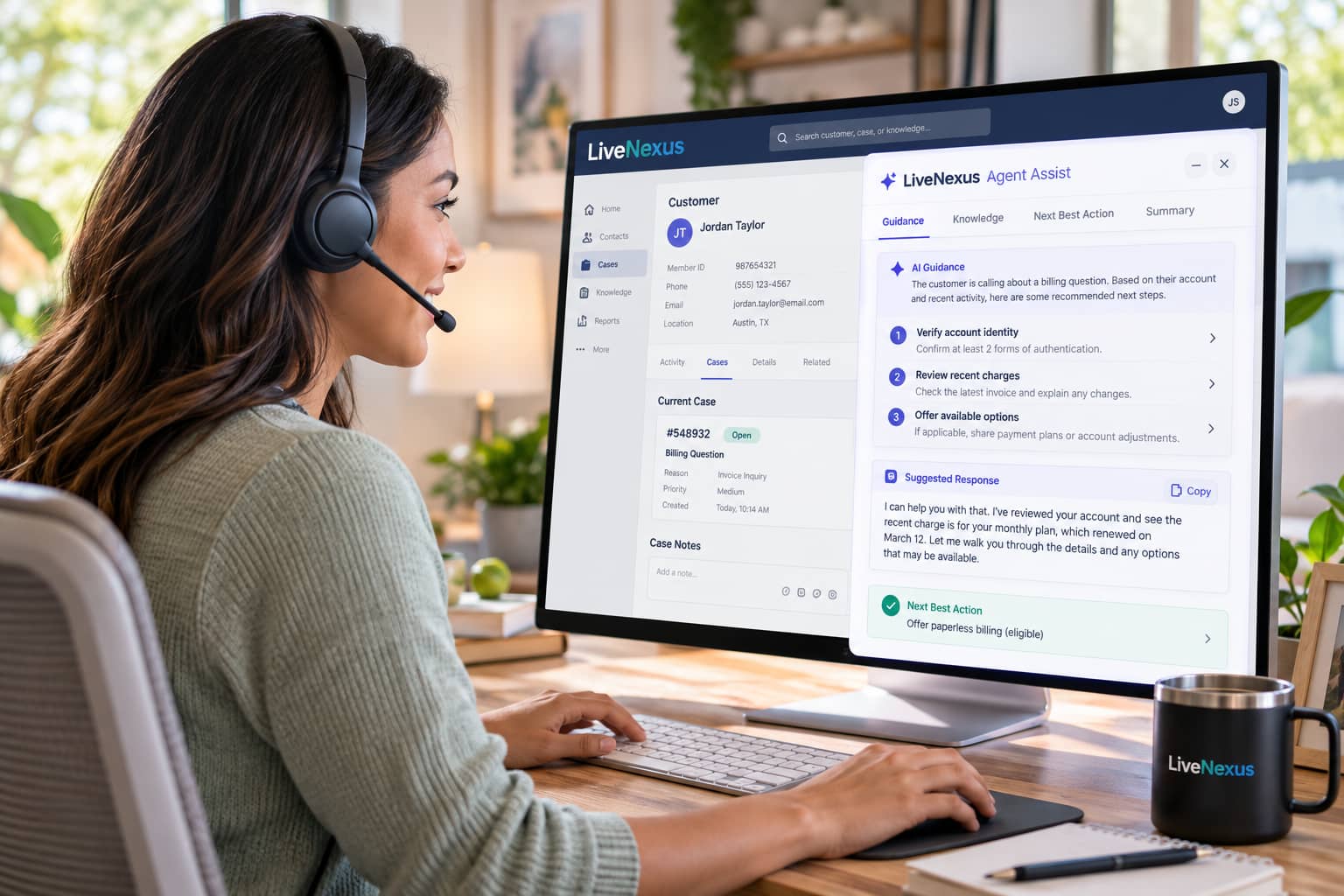
For organizations looking to move quickly, solutions like LiveNexus Agent Assist by Liveops offer a more flexible approach, delivering real-time AI guidance through a browser-based overlay that works alongside existing systems.
How Long Does Agent Assist Implementation Take?
The typical agent assist implementation timeline can range from a few weeks to several months, depending on the solution and deployment requirements.
A focused pilot involving a limited number of agents and use cases can often move faster than an enterprise-wide rollout requiring multiple integrations, custom workflows, and extensive security reviews.
Here’s how implementation timelines may differ:
Basic Pilot: Approximately 2–4 Weeks
A basic agent assist pilot typically focuses on a limited number of use cases and a smaller group of agents. Implementation may involve configuring AI-powered guidance, connecting essential knowledge resources, and testing the technology within existing workflows.
This approach allows organizations to evaluate performance and identify opportunities for improvement before expanding deployment.
Standard Deployment: Approximately 4–8 Weeks
A standard implementation generally involves broader workflow configuration, knowledge base integration, agent certification, and phased deployment across additional teams.
Organizations may also use this period to establish performance benchmarks, validate AI recommendations, and refine processes before expanding usage.
Complex Enterprise Deployment: Approximately 3–6 Months or Longer
Larger contact centers with multiple technology platforms, custom integration requirements, and complex compliance considerations may require a longer implementation timeline.
These deployments often involve coordination across IT, operations, security, and customer experience teams to ensure the technology supports existing business processes.
These timelines are illustrative planning estimates rather than guaranteed implementation periods. Actual deployment times vary by provider, organizational readiness, and technical requirements.
The most important consideration isn’t simply how quickly the software can be activated. It’s how quickly the technology can begin delivering measurable operational improvements.
A solution that launches quickly but requires agents to navigate additional screens or unreliable recommendations may create more friction than value.
Successful agent assist implementation should improve the way agents work, not introduce another layer of complexity.
What Factors Affect Agent Assist Implementation Timelines?
Several factors determine how quickly an organization can deploy AI agent assist software.
Integration With Existing Contact Center Systems
One of the biggest considerations is whether the solution can work alongside existing customer relationship management (CRM), ticketing, and contact center as a service (CCaaS) platforms.
Some agent assist tools require extensive integrations, custom development, or changes to existing workflows.
Others take a more flexible approach.
LiveNexus Agent Assist by Liveops uses a browser-based overlay designed to provide real-time guidance across existing systems, helping organizations introduce AI assistance without requiring a complete technology replacement.
This can reduce the complexity associated with implementation, particularly for organizations managing multiple platforms.
Knowledge Base Readiness
Agent assist software relies on accurate, accessible information to provide useful recommendations.
Before deployment, organizations may need to review existing knowledge bases, consolidate documentation, and identify approved information sources.
Outdated or conflicting content can undermine the effectiveness of AI-powered guidance.
Organizations with well-maintained knowledge resources may be able to move through this stage more quickly.
Workflow Complexity
Implementation timelines also depend on the processes being supported.
For example, deploying agent assist for frequently asked questions may be relatively straightforward.
Supporting complex healthcare inquiries, insurance workflows, financial services interactions, or highly regulated processes may require additional configuration, testing, and oversight.
The goal is to ensure the technology provides the right guidance at the right moment, based on the interaction and business requirements.
Security and Compliance Requirements
Organizations in regulated industries often need additional time for security reviews, data governance, access controls, and compliance validation.
Healthcare organizations, for example, must consider how protected health information is handled within AI-enabled workflows.
Agent assist software should reinforce established policies and procedures rather than introduce unnecessary compliance risks.
Pilot Testing and Operational Validation
Even when the technology is relatively easy to deploy, organizations should validate performance before expanding usage.
This includes evaluating the accuracy of AI recommendations, agent adoption, workflow effectiveness, and measurable changes in operational performance.
A phased rollout allows organizations to identify opportunities for improvement before deploying the technology more broadly.
How to Implement Agent Assist in a Contact Center
A successful agent assist deployment should follow a structured approach that connects technology implementation to measurable business outcomes.
Step 1: Identify High-Impact Use Cases
Start with processes where agents spend significant time searching for information, navigating systems, or completing repetitive tasks.
Define measurable goals such as lower average handle time, improved first-call resolution, or more consistent quality assurance.
Step 2: Assess Technology and Knowledge Readiness
Evaluate existing CRM, CCaaS, ticketing, and knowledge management systems.
Identify integration requirements and ensure the information used by AI is accurate, accessible, and approved.
Step 3: Configure and Test the Solution
Establish workflows, configure real-time guidance, validate security requirements, and test AI recommendations against real customer service scenarios.
The goal is to ensure agents receive relevant information when they need it.
Step 4: Launch a Controlled Pilot
Introduce agent assist to a defined group of agents, gather feedback, and measure performance against established benchmarks.
A controlled pilot helps organizations identify potential challenges before broader deployment.
Step 5: Optimize and Expand
Refine AI recommendations, address workflow gaps, and expand agent assist to additional teams or use cases once the solution demonstrates measurable value.
Ongoing optimization helps ensure the technology continues supporting business objectives as customer needs evolve.
Why Agent Assist Implementation Speed Matters
Speed to deployment is important, but speed to value matters more.
Contact centers evaluating AI solutions should consider how quickly the technology can begin improving operational performance without creating unnecessary disruption.
A well-implemented agent assist solution can help organizations:
- Reduce average handle time: Surface relevant information during interactions so agents spend less time searching for answers.
- Improve first-call resolution: Help agents identify appropriate next steps and resolve more customer inquiries during the initial interaction.
- Support QA consistency: Reinforce approved processes, required disclosures, and established service standards.
- Accelerate agent proficiency: Provide real-time workflow guidance that helps newer agents navigate complex interactions.
- Reduce system switching: Make relevant information available within existing workflows rather than requiring agents to navigate multiple applications.
- Improve customer experiences: Allow agents to focus more attention on the customer instead of searching for information.
These benefits depend on the quality of implementation, the accuracy of AI recommendations, and how effectively the technology fits into existing workflows.
Implement Agent Assist Without Replacing Your Existing Systems
For many organizations, the biggest barrier to AI adoption isn’t a lack of interest. It’s the complexity of introducing new technology into an already established contact center environment.
Replacing a CCaaS platform or rebuilding existing workflows can increase costs, extend deployment timelines, and introduce operational risks.
That’s why organizations should evaluate whether agent assist can work within their current technology environment.
LiveNexus Agent Assist by Liveops is designed to bring AI-powered guidance directly into existing agent workflows through a browser-based overlay.
Rather than requiring agents to navigate another disconnected application, the solution provides contextual information and recommended next steps as they work.
Combined with Liveops’ more than 26 years of customer experience expertise, this approach connects AI capabilities with real-world operational knowledge.
The result is a more practical path toward AI-enabled customer service, with a focus on improving agent performance, operational consistency, and measurable business outcomes.
The Best Agent Assist Implementation Starts With Business Outcomes
The question shouldn’t only be how quickly agent assist can be implemented.
It should be whether the solution can improve the customer experience, support agents, and deliver measurable operational value.
Organizations that prioritize integration flexibility, knowledge accuracy, workflow alignment, and ongoing optimization are better positioned to realize the benefits of AI-powered agent assistance.
With LiveNexus Agent Assist, Liveops helps organizations introduce AI guidance into existing customer service environments without making technology replacement the starting point.
Because successful AI adoption isn’t measured by how quickly a tool goes live. It’s measured by what improves once it does.
Frequently Asked Questions About Agent Assist Software
- How can agent assist improve CSAT, QA consistency, and first-call resolution?
Agent assist can improve customer satisfaction (CSAT), quality assurance (QA) consistency, and first-call resolution (FCR) by providing agents with real-time information, recommended next steps, and consistent workflow guidance. This helps reduce errors, unnecessary transfers, and repeat interactions.
LiveNexus Agent Assist by Liveops supports these outcomes by delivering contextual guidance directly into existing agent workflows, helping agents provide more accurate, consistent, and efficient customer service.
- How does agent assist help with HIPAA compliance?
Agent assist can support HIPAA compliance efforts by surfacing approved procedures, reminding agents of required verification steps, and reinforcing appropriate handling of sensitive patient information. However, agent assist software doesn’t make an organization HIPAA-compliant on its own.
Liveops and LiveNexus Agent Assist help healthcare organizations reinforce established workflows through real-time guidance. Any deployment involving protected health information must also meet applicable privacy, security, and contractual requirements, including appropriate safeguards and business associate agreements where required.
- How does agent assist help with compliance?
Agent assist supports contact center compliance by providing real-time reminders, required disclosures, policy guidance, and workflow instructions during customer interactions. This can help reduce procedural errors and improve consistency across agents.
LiveNexus Agent Assist by Liveops helps reinforce approved processes by making relevant compliance guidance available within the agent experience, supporting more consistent execution across regulated and nonregulated industries.
- How can healthcare contact centers use agent assist?
Healthcare contact centers can use agent assist for appointment scheduling, benefits verification, claims inquiries, patient support, knowledge retrieval, and workflow guidance.
Liveops combines healthcare CX expertise with LiveNexus Agent Assist to help agents navigate complex healthcare interactions more efficiently while maintaining the human judgment and empathy essential to patient and member experiences.
- How can agent assist reduce average handle time?
Agent assist can reduce average handle time (AHT) by minimizing the time agents spend searching for information, navigating multiple systems, and completing repetitive tasks. Real-time recommendations help agents identify relevant answers and next steps faster.
LiveNexus Agent Assist by Liveops provides contextual guidance through a browser-based overlay, helping agents access information without unnecessary system switching. Actual AHT improvements depend on workflow design, adoption, and implementation quality.
- Is it better to use an agent assist tool built into my CCaaS platform or a standalone one?
The better option depends on an organization’s existing technology, integration requirements, and operational goals.
Built-in CCaaS agent assist tools may offer convenient native functionality, while standalone solutions can provide greater flexibility across multiple systems and vendors.
LiveNexus Agent Assist by Liveops is designed to work alongside existing CX technology through a browser-based overlay, making it an attractive option for organizations that want AI-powered guidance without replacing their current CCaaS platform.
- How can agent assist help new contact center agents reach proficiency faster?
Agent assist can accelerate agent proficiency by providing real-time answers, step-by-step workflow guidance, and contextual recommendations during live customer interactions. This reduces reliance on memorized information and constant supervisor assistance.
Liveops uses its extensive CX operational experience alongside LiveNexus Agent Assist to help agents access relevant guidance as they work, supporting faster proficiency and more consistent customer interactions.
- What is agent assist and how does it work in a call center?
Agent assist is AI-powered software that supports human customer service agents during live interactions by providing relevant information, recommended responses, knowledge retrieval, and workflow guidance.
Rather than replacing agents, the technology works alongside them to improve efficiency and decision-making.
LiveNexus Agent Assist by Liveops delivers this support through a browser-based overlay that brings contextual guidance into existing contact center workflows.
- Do agent assist tools actually reduce handle time and improve first-call resolution?
Agent assist tools can reduce average handle time and improve first-call resolution by helping agents find accurate information faster, follow established procedures, and resolve customer issues without unnecessary transfers or repeat contacts.
However, results vary depending on implementation quality, knowledge accuracy, and agent adoption.
LiveNexus Agent Assist by Liveops is designed to support these outcomes through real-time guidance and workflow assistance, helping organizations target measurable improvements in contact center performance.
- What’s the difference between agent assist and full AI automation?
Agent assist supports human agents by providing recommendations, relevant information, and workflow guidance during customer interactions. Full AI automation allows AI systems to handle designated tasks or customer interactions with limited or no direct human involvement.
Liveops addresses both approaches through LiveNexus, including LiveNexus Agent Assist for human-led interactions and LiveNexus Voice Resolve for AI-powered voice automation.
The right approach depends on the complexity of the interaction, customer needs, and business objectives.
- What is the best agent assist software for contact centers?
The best agent assist software depends on an organization’s technology environment, integration requirements, compliance needs, and performance goals.
Leading options include LiveNexus Agent Assist, NICE CXone Copilot, Cresta Agent Assist, Balto, Genesys Agent Copilot, and Verint Copilots.
LiveNexus Agent Assist by Liveops is particularly worth considering for organizations seeking browser-based flexibility, real-time guidance, and the ability to introduce AI without replacing existing contact center systems. Liveops also brings more than 26 years of CX operational experience to implementation and workflow optimization.
- How can contact centers modernize with agent assist without replacing their existing systems?
Contact centers can modernize by choosing agent assist technology that integrates with or operates alongside existing CRM, ticketing, knowledge management, and CCaaS platforms.
This allows organizations to introduce AI capabilities without undertaking a complete infrastructure replacement.
LiveNexus Agent Assist by Liveops uses a browser-based overlay to provide contextual guidance across existing agent workflows, helping organizations modernize customer service operations while preserving their current technology investments.
- How much does agent assist software cost?
Agent assist software costs vary depending on the provider, pricing model, number of users, interaction volume, features, and integration requirements.
LiveNexus Agent Assist by Liveops offers organizations an alternative focused on integrating AI guidance into existing workflows. Organizations should contact Liveops for pricing based on their specific requirements and deployment scope.
- How long does it take to implement agent assist in a contact center?
Agent assist implementation can take anywhere from a few weeks for a focused pilot to several months for a complex enterprise deployment. Timelines depend on integration requirements, knowledge base readiness, security reviews, and workflow complexity.
LiveNexus Agent Assist by Liveops is designed to simplify deployment through its browser-based overlay, allowing organizations to introduce AI guidance alongside existing systems. Specific implementation timelines should be confirmed with Liveops based on the organization’s environment.
- Which agent assist platforms work across existing CRM, ticketing, and CCaaS systems?
Several agent assist platforms support integrations with existing customer service technology, including LiveNexus Agent Assist, Cresta, Google Cloud Agent Assist, and other enterprise AI solutions. Integration capabilities vary by provider, platform, and configuration.
LiveNexus Agent Assist by Liveops differentiates itself through its browser-based overlay, designed to provide real-time guidance across existing workflows without requiring organizations to replace their CRM, ticketing, or CCaaS systems. Compatibility with specific applications should be validated during implementation planning.


Let’s connect
Sales reps are available to help you meet your customer service needs with greater flexibility, lower cost, and better outcomes.
Related Resources

AI for Customer Support: Benefits, Use Cases, and Best Practices →

How to Operationalize AI: Turning AI Ideas into Business Outcomes →

Outsourced Customer Service: How It Works, Benefits, and How to Choose the Right Provider →
Stop outsourcing, start outsmarting
Join the brands redefining customer experience with Liveops. Empathetic agents, tech-powered delivery, and the flexibility to meet every moment. Let’s talk.

Explore flexible customer experience solutions