
Customers Are Doing Their Homework With AI; Six in Ten Say They Arrive to Customer Service Interactions Better Prepared
minutes

The Liveops 2026 AI-Empowered Customer Report finds 72% of AI users have fixed a problem without contacting the company, and most expect the customer service representative they do reach to know more than their AI does.
Customers have always looked for answers before contacting a company. AI now helps them do more on their own.
They can use tools like ChatGPT to understand a confusing policy or work through a problem. Some find what they need without ever contacting customer service.
Those who still need help may already know the policy and have tried a few solutions. They want someone who can check what the AI told them and help resolve what’s left. That might mean looking into their account, approving a refund, or explaining why a different solution is needed.
The Liveops 2026 AI-Empowered Customer Report set out to measure how customers use their own AI tools before and during customer service interactions. The findings show how this shift is changing customer behavior and what it means for the organizations responsible for delivering resolution.
Purpose of this Study
The Liveops 2026 AI-Empowered Customer Report was conducted in October 2026 via Pollfish among 750 U.S. adults ages 18+ who had used their own AI tool, such as ChatGPT, Gemini, Claude or Copilot, in the past year to help with a company’s customer service. The survey measured how customers use those tools and what they expect from the person they reach once their research is done. The research was conducted by Liveops, a leader in customer experience outsourcing solutions.
Key Findings of the Liveops 2026 AI-Empowered Customer Report
Customers are using AI to prepare and solve problems.
- 60% feel more prepared for customer service after using their own AI tool.
- 72% report having used personal AI to resolve a problem without contacting the company.
- 86% say their personal AI tools have been helpful in understanding matters such as bills, policies, and company decisions.
Customers expect human support to provide more than information.
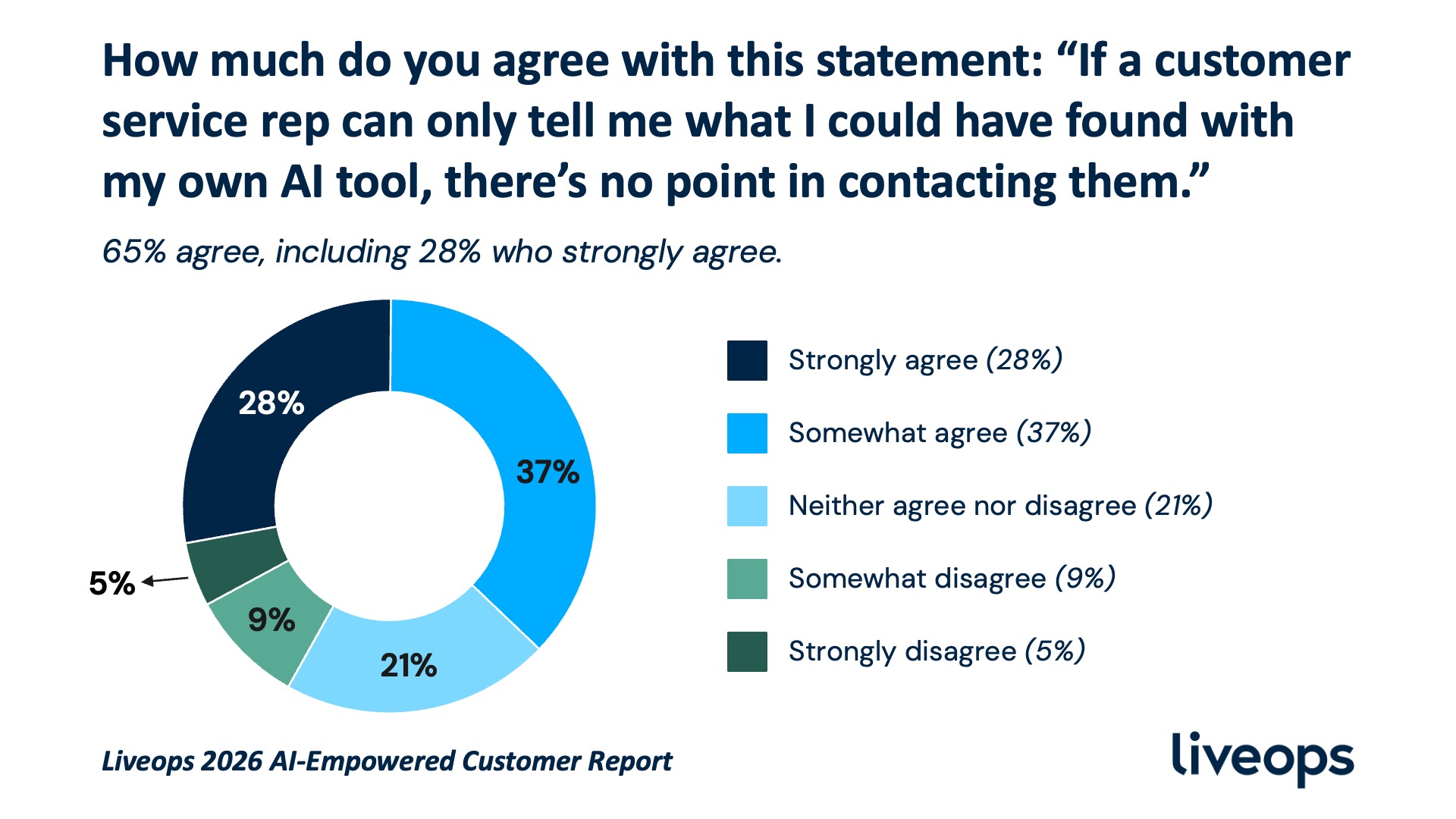
- 65% agree there is little point contacting a CX representative who can only repeat information available through their own AI.
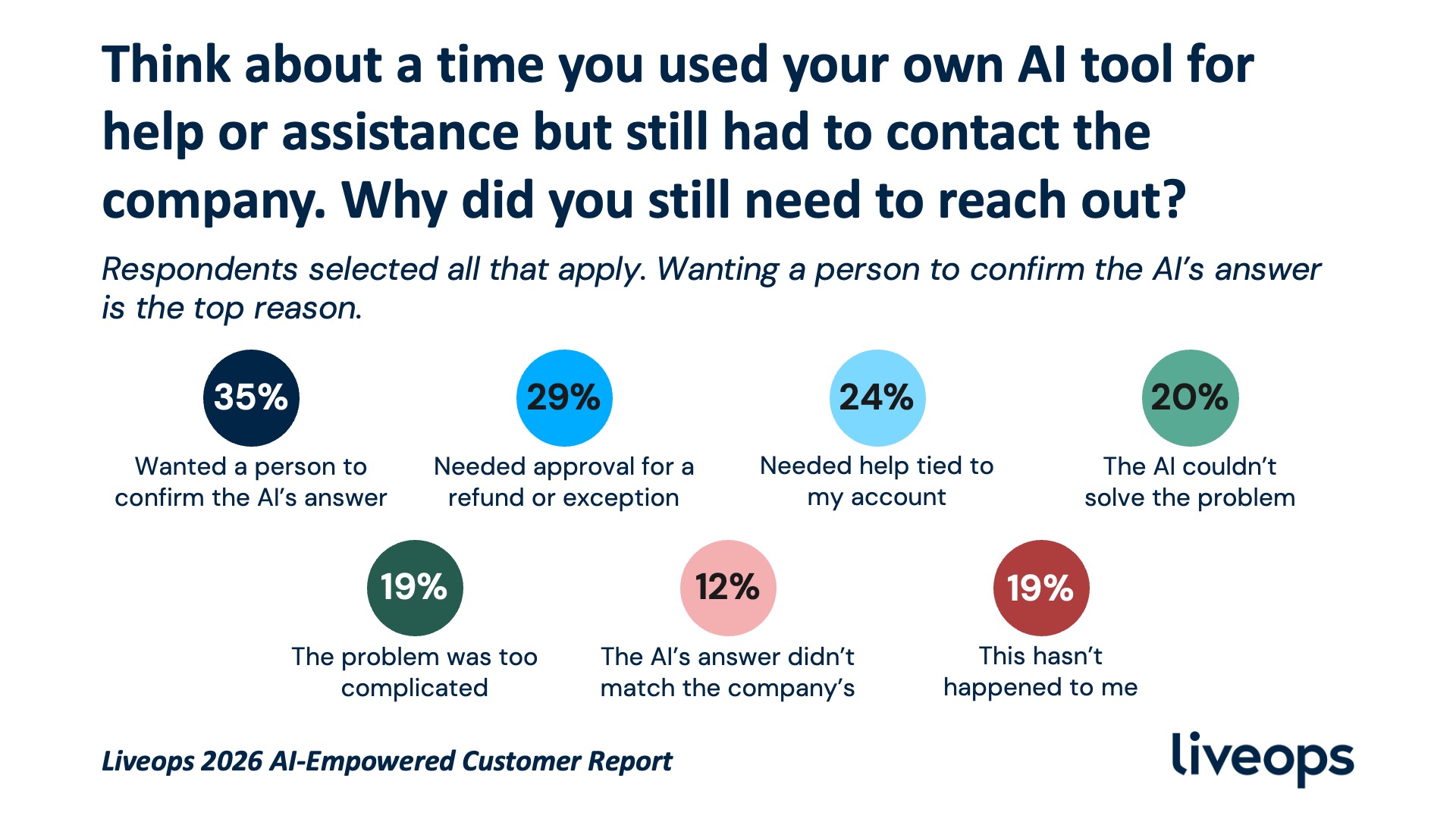
- 35% cite wanting a person to confirm AI-provided information as a reason for contacting a company after using personal AI.
- 29% cite needing someone authorized to approve a refund, credit, or exception.
Continuity remains a significant challenge.
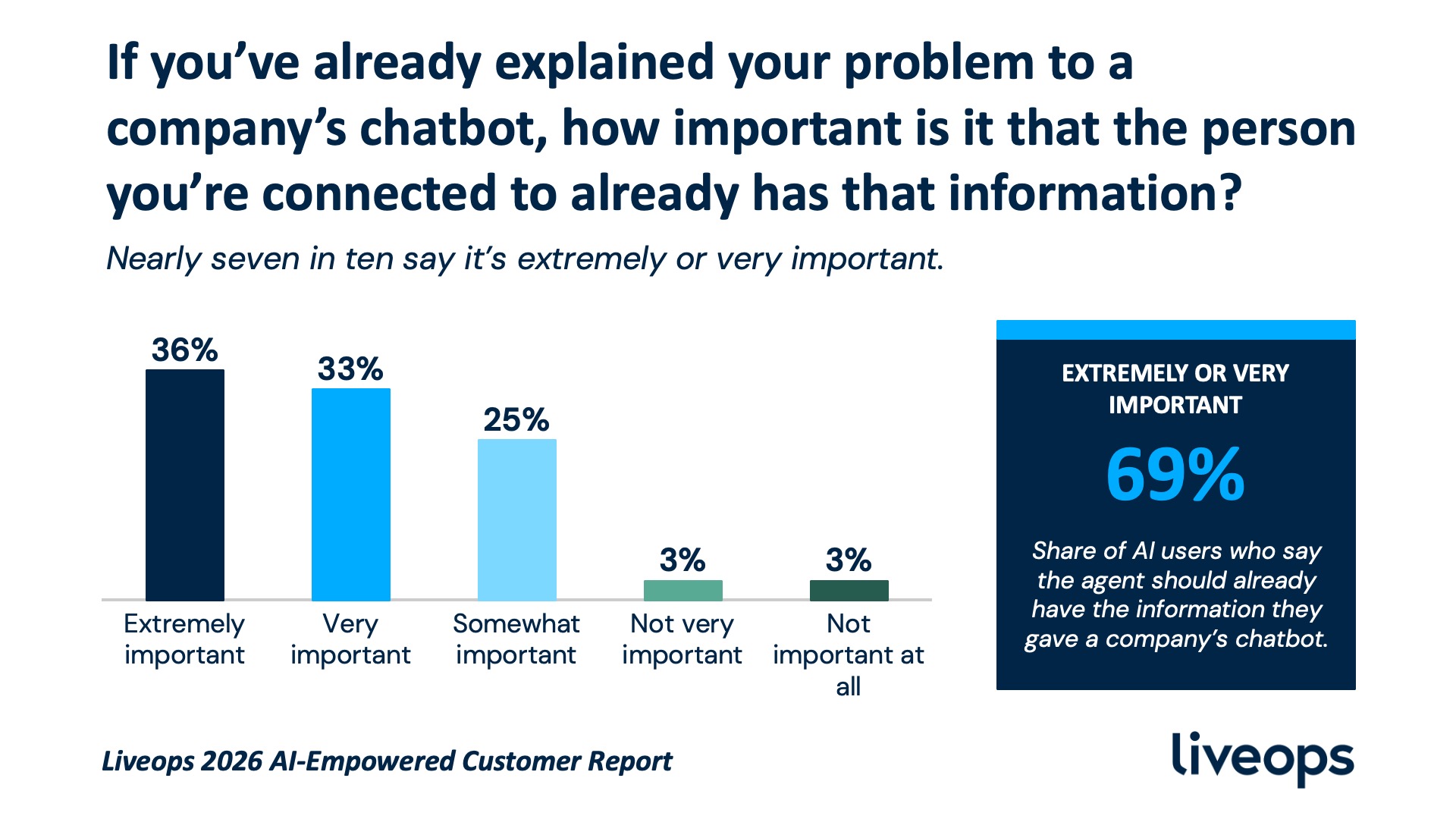
- 69% consider it extremely or very important that a representative already has the information they provided to a company chatbot.
- 84% report having had to repeat information previously given to a chatbot, including 37% who say it happens frequently.
Resolution matters more than the channel.
- 50% say getting the problem fixed matters most, whether a company chatbot or a person handles it, while 30% prefer a person even if resolution takes longer.
“AI is changing the customer before the customer ever reaches the company,” said Molly Moore, President and Chief Operating Officer of Liveops. “People show up having done their homework. They know what they want to ask, and a lot of them already have a fix in mind. What they want from a human agent now is someone who can confirm what they’ve found and make the call that actually solves the problem. Companies need to get their people and their operations ready for that customer.”
How Customers Are Using Their Own AI Tools Before They Contact a Company
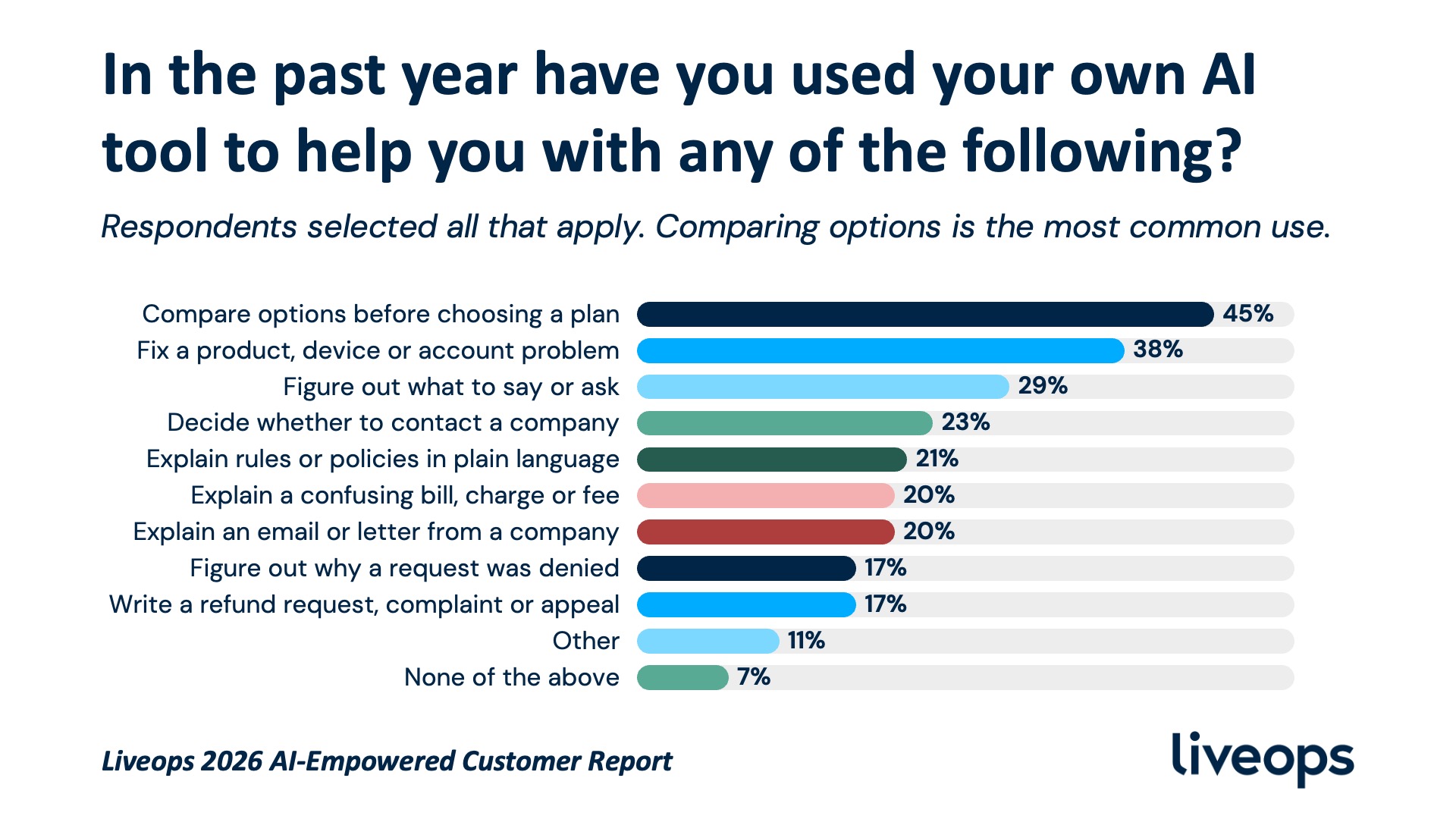
Comparing options is the most common way customers put their own AI tools to work on customer service. Nearly half of respondents (45%) have used AI in the past year to compare their options before choosing a plan or solution, and 38% have used it to fix a problem with a product or account.
Many also use AI to get ready for the conversation itself. Close to three in ten (29%) have used it to figure out what to say or ask before contacting a company, while 23% have used it to decide whether they needed to contact the company at all. Smaller shares turn to AI to explain a company’s policies in plain language (21%) or make sense of a confusing bill or fee (20%). Some go a step further and have AI help write a refund request or appeal (17%).
Personal AI has become one stop in a longer routine. When they have a problem with a company, 35% of respondents usually ask their own AI tool for help before contacting customer service, about the same share that uses the company’s own chatbot (37%) or gathers receipts and account details (36%). Searching online (49%) and checking the company’s website or help page (45%) still come first for most people.
Sometimes the research settles the problem before anyone at the company hears about it. Nearly three in four respondents (72%) have used their own AI tool in the past year to fix a problem on their own so they didn’t need to contact the company at all. That includes 40% who have done it a few times and 15% who have done it many times. For contact centers, it suggests many of the customers who do reach out are bringing problems they couldn’t settle on their own.
“AI tools help me know what questions to ask once I contact the company’s customer service department.”

Why Customers Feel More Prepared After Asking AI First
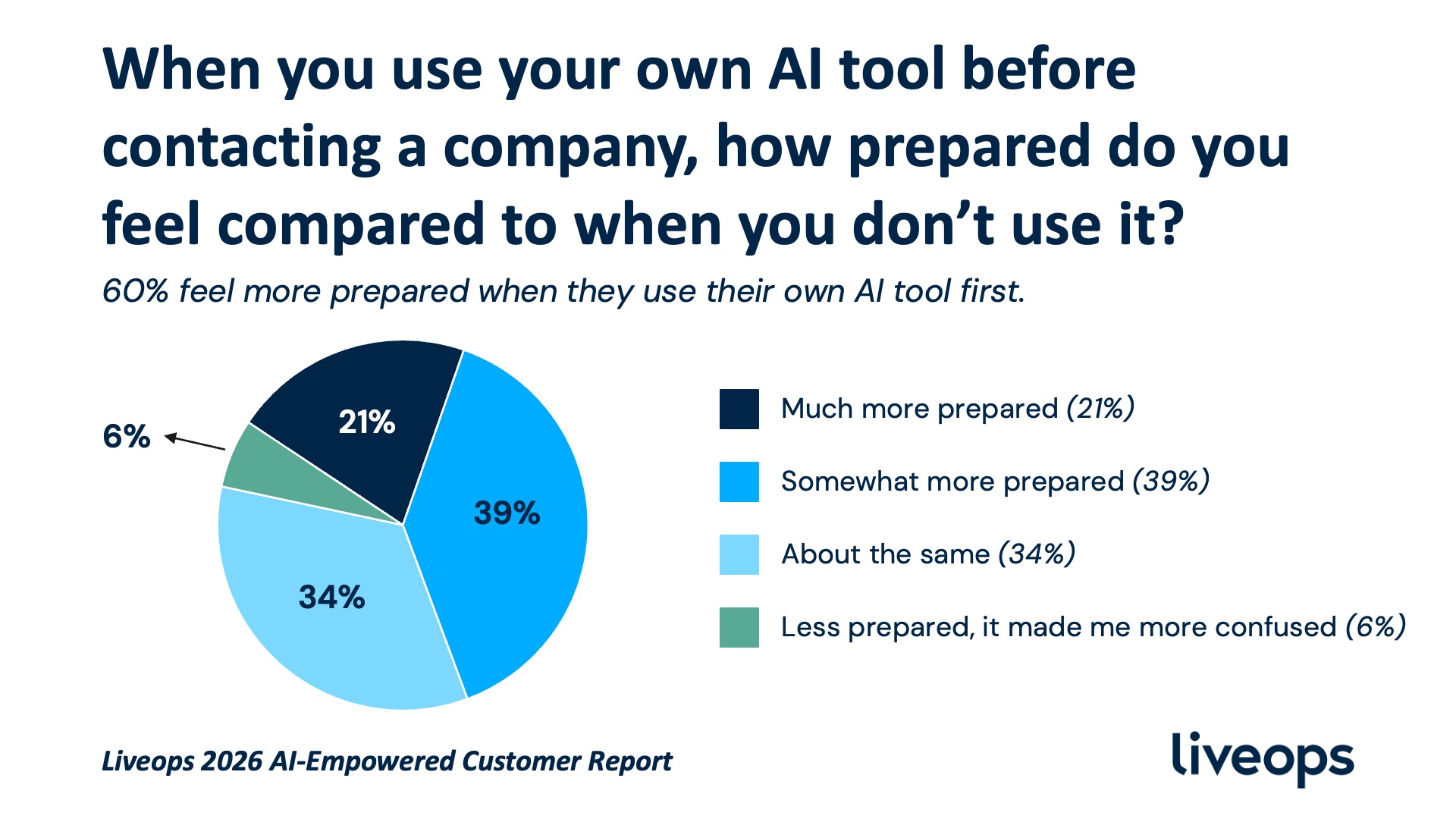
Six in ten respondents (60%) say they feel more prepared going into a customer service interaction when they use their own AI tool first. That includes 21% who feel much more prepared and 39% who feel somewhat more prepared. Another 34% feel about the same, and only 6% say AI left them more confused.
Customers also give their AI tools good marks for usefulness. The vast majority (86%) say their own AI tool has been very or somewhat helpful over the past year in making sense of things like bills and company policies. Just 4% say it hasn’t helped at all.
Respondents also express confidence in their ability to use personal AI when communicating with companies. Nearly three-quarters of respondents (73%) say they use, or could use, their own AI tool very well or fairly well to get a good result when they have a problem with a company. Only 18% say they don’t use it well.
The result is a customer who shows up with a working theory of the problem and some idea of the fix. For customer service teams, the opportunity is to build on that preparation rather than repeat it, directly progressing the interaction toward an informed and quicker decision or resolution.
“My AI tool helped me solve the issue by laying out the facts and how it arrived at the conclusion, so I could share it with the customer representative who could fix the problem right away.”

How Customers Are Turning to AI for Help Getting Results
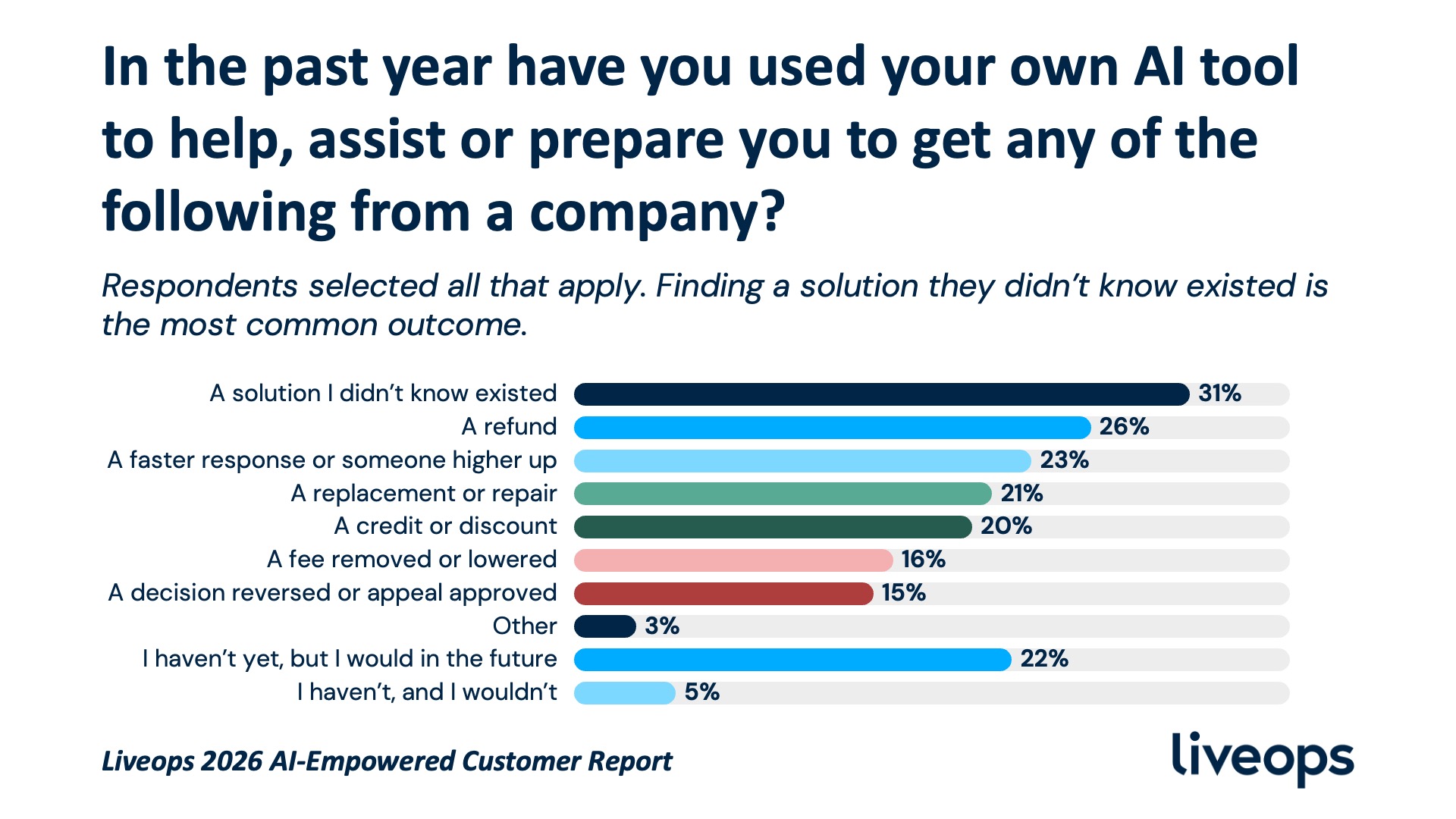
Preparation is paying off in concrete ways. Nearly one in three respondents (31%) say their own AI tool helped them find a solution they didn’t know existed, the most common outcome of the report. Another 26% used AI to help get a refund, and 23% used it to get a faster response or reach someone higher up. The findings suggest some customers now use personal AI to work through company processes and arrive with a better-prepared request.
Money is part of the story too. One in five (20%) used AI to help secure a credit or discount, and 16% used it to get a fee removed or lowered. Among respondents who haven’t used AI this way, most are open to it: 22% say they haven’t yet but would in the future, compared with 5% who say they wouldn’t.
Customers are also bringing what AI tells them straight into the conversation. More than half (52%) have repeated something their own AI tool told them, such as a company policy or their rights as a customer, to make their case with a company in the past year. For 30%, it helped. Another 16% say it didn’t make a difference, and 6% found out the AI was wrong.
That 6% is a small group, and it still matters to the customer service representative on the line. When a customer’s AI-generated answer conflicts with the company’s records, the representative needs current policy information on hand and the skill to explain the decision clearly.
“I had a claim denied at [insurance company] and AI said it should have paid, so I called and told them what I found and they paid it.”

When Information Isn’t Enough, Customers Still Need Human Expertise
Even well-prepared customers reach a point where they want a person involved. When respondents used their own AI tool but still had to contact the company, the top reason was wanting a real person to confirm what the AI told them (35%). Close to three in ten (29%) needed someone with the authority to approve a refund or make an exception, and 24% needed help with something tied to their own account. Fewer (20%) reached out because the AI couldn’t solve or make sense of the problem.
That puts customer service representatives at the end of the customer’s research, where the work is confirming the answer and acting on it. Speed counts at that stage. When customers reach a real person after looking into a problem with their own AI tool, the most important thing to them is that the person fixes it quickly (32%), followed by being friendly and showing empathy for their situation (19%). Not every interaction needs a human. But when it does, customers need to be able to reach someone with the knowledge and authority to solve the problem.
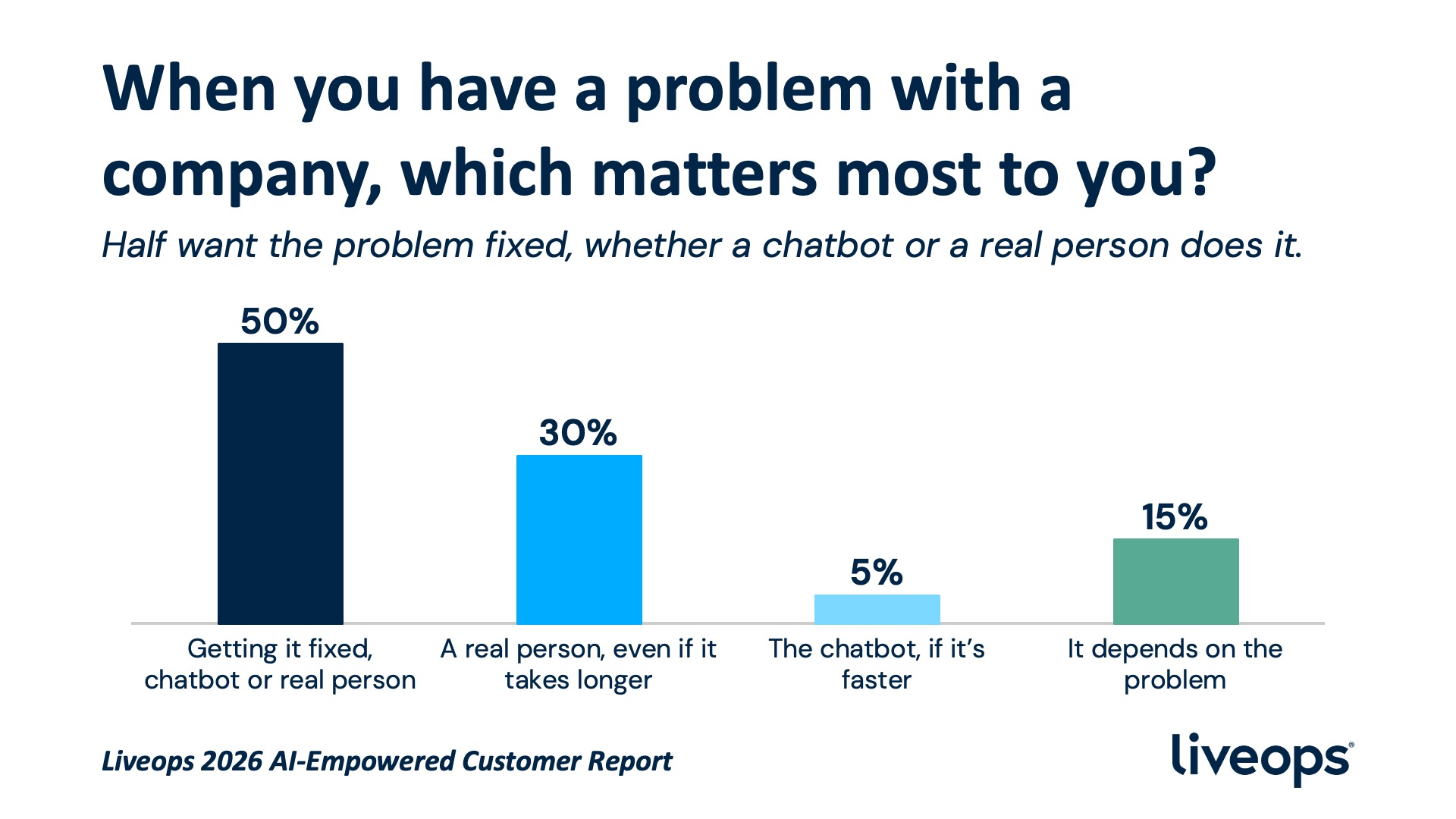
Customers care more about the fix than about who delivers it. Half of respondents (50%) say getting the problem fixed matters most, whether a company’s chatbot or a real person does it. Another 30% would rather have a real person fix it even if it takes longer, compared with 5% who prefer the chatbot if it’s faster.
“I was able to get the answers I needed and the issue was resolved with me having the peace of mind knowing this person knew their job.”


What Customers Expect From Customer Service Representatives After Doing Their Own Research
When customers have already done the research, they expect the customer service representatives to add something to it. Nearly two in three respondents (65%) agree there’s no point in contacting a customer service representative who can only tell them what they could have found with their own AI tool. That includes 28% who strongly agree. Just 14% disagree.
As customers gain easier access to information, simply providing an answer becomes less differentiating. The value of customer service increasingly depends on what happens beyond that answer: whether the representative can explain a decision, reconcile conflicting information, understand the customer’s circumstances, and take appropriate action.
This creates a different expectation for frontline teams. Human agents need more than scripts and access to a knowledge base. They need reliable context, clear decision rights, effective tools, and the judgment to navigate situations that don’t fit a standard process.
Many say they’re already a step ahead. Nearly four in ten (38%) say the representative they reach frequently or almost every time tells them something they’d already found on their own. Another 50% say it happens sometimes, which brings the share who experience it at least sometimes to 88%.
Customers who hear a different answer than what they anticipated for from the representative tend to ask questions before they decide what’s true. If their own AI tool said they were owed a refund and a representative who knows the policy said no, half of respondents (50%) would ask the representative more questions based on what the AI told them. Fewer would simply trust the representative (18%) or their own AI tool (10%), and 14% would look for another source before deciding. Customer service representatives should still expect customers to ask them to walk through the reasoning behind a decision, even if they come equipped with information.
Patience is wearing thinner as well. Since they started using their own AI tool to look into problems, 31% of respondents say they’ve become less patient with having to repeat information, and 30% are less patient with being transferred. Another 22% have less patience for talking to someone who seems to know less than they do, while 27% say their patience hasn’t changed.
“An AI tool told me the policy for [payment app], so when I talked to customer service I was able to pull up the specific policy rules and send a screenshot to the rep.”

Why Context Has to Follow the Customer From the Chatbot to the Human Agent
A customer’s preparation only helps if it survives the handoff. Nearly seven in ten respondents (69%) say it’s extremely or very important that the person they’re connected to already has the information they gave a company’s chatbot. More than one-third (36%) call it extremely important and say they shouldn’t have to start over. Only 6% say it isn’t very important or isn’t important at all.
Personal AI can help customers arrive better prepared, but that head start disappears when a company’s own systems lose the context. A customer who has already researched the issue and walked a chatbot through it shouldn’t have to start over with a representative. Making them repeat that work only adds effort.
Getting the handoff between AI and people right is an operating question for the whole company. A good handoff carries forward what the customer has already explained and why the issue was escalated, so the representative can pick up where the conversation left off.
Handoffs often fall short of that. The vast majority of respondents (84%) have had to repeat information to a real person that they’d already given a company’s chatbot, including 37% who say it happens frequently. The Liveops 2026 Resolution Gap Report found the same friction from another angle, with 59% of customers saying handoffs feel difficult because they have to explain the issue again.
Customers have a clear picture of what should carry over. When a chatbot connects them to a real person, 61% expect that person to already know the problem they described, and 57% expect them to know their name and account details. Close to half expect the representative to know the steps they already tried (47%) or what the chatbot already told them (45%).
“I had to talk to the internet company and had to repeatedly tell each person I talk to what the problem was. If you offer AI services at all, you should definitely offer the option to have that information transferred between agents.”

What Comes Next for CX Leaders
The Liveops 2026 AI-Empowered Customer Report shows that customers are doing more of their own homework before they reach a company, and most of them come away better prepared. A customer who has already read the policy and tried a fix the issue on their own gives the customer service representative a head start, as long as the agent is ready to progress the conversation. Liveops recommends six priorities for CX leaders.
- Start where the customer left off. Give customers an easy way to share what they’ve already tried, and give representatives the knowledge to check that research against company sources and take the next step.
- Organize AI and human work around resolution. Map each request from first contact to completed action, and decide what AI can handle alone and when a person needs to step in. Measure resolved issues and repeat contacts alongside speed and automation rates.
- Make Agent Assist a source of guidance and action. Real-time guidance like LiveNexus Agent Assist should connect representatives to current company knowledge and the customer’s history so they can verify information and explain decisions. The steps a customer already tried should travel with the issue as it moves between people and AI.
- Build expertise through continuous learning and AI simulations. As AI takes on more predictable work, use AI-powered simulations to give representatives practice with harder conversations, like a customer challenging a policy based on their own AI research. Strong learning and development programs that draw on real service challenges help agents get up to speed faster.
- Give people the authority to act. Representatives need clear decision rights and escalation paths so their expertise turns into action. As AI takes on more work, assign people responsibility for what it’s allowed to do and prepare supervisors to coach in a blended operation.
- Turn every interaction into better operations. Customer conversations show where knowledge is missing and handoffs break. Build a recurring process to turn those signals into updated guidance and training, then measure whether each change works.
For CX leaders, the takeaway is that a more prepared customer raises the bar for every conversation that follows. Companies that get their representatives ready for that customer can earn the trust that comes with a confident answer.
“The real question for CX leaders isn’t whether customers are using AI. They are. The question is whether the organization is prepared for what happens next,” Moore said. “When customers arrive with more information, the answer isn’t simply giving agents more technology. It’s making sure the entire operation can build on what the customer already knows, bring in human judgment where it matters, and move the issue toward resolution. That’s how AI becomes part of a better customer experience rather than another layer of complexity.”
Frequently Asked Questions About AI-Empowered Customers and Customer Service
How are customers using AI tools like ChatGPT for customer service interactions?
Customers are using AI tools like ChatGPT for customer service most often to compare their options before choosing a plan or solution (45%) and to fix problems with a product or account (38%), according to the Liveops 2026 AI-Empowered Customer Report. Many skip the call entirely, with 72% of AI users saying they’ve used their own AI tool to fix a problem without contacting the company at all.
Does using AI before calling customer service help?
Using AI before calling customer service helps most customers feel ready for the conversation, with six in ten AI users (60%) saying they feel more prepared when they use their own AI tool first, Liveops’ report found. Only 6% say it left them more confused.
Can AI help you get a refund from a company?
AI can help customers get a refund from a company, with 26% of AI users saying their own AI tool helped them get a refund and 20% saying it helped them secure a credit or discount, according to Liveops’ research. More than half (52%) have repeated something their AI tool told them, such as a company policy, to make their case, and 30% say it helped.
What do customers expect from customer service agents after using AI?
Customers who have already used AI expect customer service agents to know more than they could find on their own, with 65% agreeing there’s no point in contacting a rep who can only tell them what their own AI tool could have, Liveops’ report found. Nearly four in ten (38%) say the rep they reach frequently or almost every time tells them something they’d already found.
Do customers trust AI or customer service representatives more?
Customers don’t automatically trust AI or customer service representatives more when the two disagree, and half of AI users (50%) say they’d ask the representative more questions based on what their AI tool told them, according to the Liveops 2026 AI-Empowered Customer Report. Only 18% would simply trust the representative, and 10% would trust their own AI tool.
Why do people still call customer service if they can ask AI?
People still call customer service after asking AI most often because they want a real person to confirm what the AI told them (35%), Liveops’ research found. Close to three in ten (29%) need someone with the authority to approve a refund or make an exception.
Is AI making customers less patient with customer service?
AI is making many customers less patient with customer service, with 31% of AI users saying they’ve become less patient with repeating information and 30% saying they’re less patient with being transferred since they started using their own AI tool, according to Liveops’ report. Just 27% say their patience hasn’t changed.
How often do customers have to repeat themselves after a chatbot transfers them to an agent?
Customers often have to repeat themselves after a chatbot transfers them to an agent, with 84% of AI users saying they’ve had to repeat information they’d already given a company’s chatbot, the Liveops 2026 AI-Empowered Customer Report found. Nearly four in ten (37%) say it happens frequently, and 69% say it’s extremely or very important that the agent already has that information.
How should customer service teams prepare for customers who use AI?
Customer service teams should prepare for customers who use AI by giving agents the context from earlier interactions and the authority to make decisions, based on findings from the Liveops 2026 AI-Empowered Customer Report. Close to three in ten AI users (29%) contacted a company because they needed someone who could approve a refund or make an exception, and 69% say it’s extremely or very important that agents already have what they told a chatbot.
Survey Methodology
The Liveops 2026 AI-Empowered Customer Report was conducted in October 2026 via Pollfish among 750 U.S. adults ages 18+ who had used their own AI tool, such as ChatGPT, Gemini, Claude or Copilot, in the past year to help them make sense of something or figure something out before or while dealing with a company’s customer service. The survey assessed how customers use their own AI tools before and during customer service interactions and what they expect once they reach a person. The research was conducted by Liveops, a leader in AI-powered flexible customer experience outsourcing solutions.


Let’s connect
Sales reps are available to help you meet your customer service needs with greater flexibility, lower cost, and better outcomes.
Related Resources

Philippines Customer Service: A Complete Guide to Outsourcing Customer Support in 2027 →

How Much Does Call Center Outsourcing Cost? 2027 Pricing Guide →

The New Geography of Healthcare CX: Why Organizations Are Rethinking Where Patient Support Happens →
Stop outsourcing, start outsmarting
Join the brands redefining customer experience with Liveops. Empathetic agents, tech-powered delivery, and the flexibility to meet every moment. Let’s talk.

Explore flexible customer experience solutions