

Beyond Agent Assist: Why AI Orchestration Is the Future of Customer Experience
minutes

Why customer experience leaders should think beyond individual AI solutions
Artificial intelligence has become a core part of the customer experience conversation. Organizations are investing in virtual agents, Agent Assist, intelligent routing, workflow automation, and AI agents to improve efficiency and enhance customer experiences.
As these capabilities mature, many organizations face a different challenge. The question is no longer what each technology does. The question is how they work together.
Agent Assist and AI orchestration are complementary capabilities that solve different problems.
Agent Assist helps customer service professionals deliver better interactions. AI orchestration connects AI capabilities, people, enterprise data, business rules, workflows, and enterprise systems so the customer journey operates as a coordinated system aligned to business outcomes.
Understanding the relationship between these capabilities is becoming increasingly important as organizations move from AI experimentation to enterprise adoption.
Explore AI for improved business outcomes
Agent Assist improves every interaction
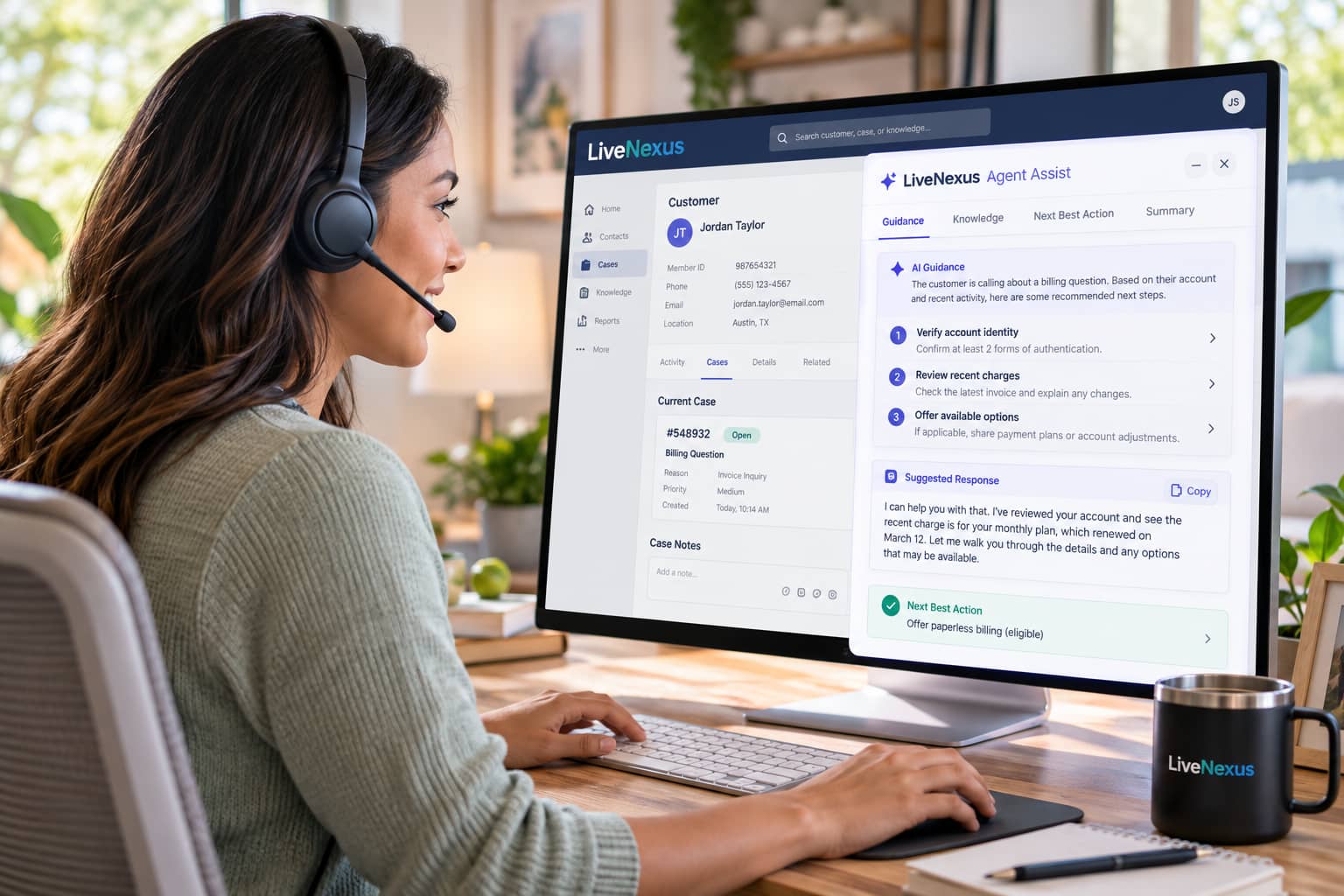
Agent Assist is designed to help customer service professionals perform at their best while engaging with customers.
Rather than replacing human expertise, it provides real-time guidance that helps agents find information faster, reduce manual effort, and make better decisions throughout the conversation.
Modern Agent Assist solutions can:
- Surface relevant knowledge instantly
- Recommend next best actions
- Generate conversation summaries
- Reduce after-call work
- Improve consistency and compliance
- Accelerate onboarding for new agents
- Support experienced agents during complex interactions
The value extends beyond productivity. Effective Agent Assist reduces cognitive load, increases confidence, improves decision quality, and allows agents to spend more time focusing on the customer instead of navigating multiple systems.
At Liveops, LiveNexus Agent Assist was designed with this goal in mind. It brings AI directly into the agent experience to improve efficiency, confidence, and customer outcomes while keeping people at the center of every interaction.
Explore LiveNexus Agent Assist
AI orchestration looks across the entire operation
If Agent Assist improves individual interactions, AI orchestration improves how the entire customer operation functions.
It serves as the intelligence layer that connects AI, people, enterprise data, business rules, workflows, and enterprise systems throughout the customer journey.
Agent Assist and AI orchestration have a continuous relationship.
AI orchestration determines when and how capabilities such as Agent Assist should be used throughout the customer journey. In return, every assisted interaction generates operational intelligence that improves the broader AI ecosystem.
Agent Assist consumes context such as customer history, enterprise knowledge, routing decisions, and business rules. It also produces valuable signals, including customer intent, sentiment, resolution outcomes, compliance events, and agent actions. Those signals become shared intelligence that benefits analytics, knowledge management, quality programs, AI model optimization, workforce optimization, and future orchestration decisions.
For example, a customer may begin with an AI agent that successfully resolves a simple request. If the issue becomes more complex, requires a licensed representative, or falls below a defined confidence threshold, orchestration determines that the interaction should be transferred to a live agent.
At that point, Agent Assist becomes part of the experience. Instead of starting from scratch, the agent receives the conversation history, an AI-generated summary, recommended next steps, relevant knowledge, and compliance guidance. The customer experiences a seamless transition while the organization captures new operational intelligence that improves future interactions across every channel.
Instead of asking:
“How can AI help this agent?”
AI orchestration asks:
“What is the best way to resolve this customer’s need while achieving the desired business outcome?”
That includes decisions such as:
- Should AI resolve this interaction independently?
- When should a customer be transferred to a human expert?
- Which agent has the appropriate skills or certifications?
- Which AI capability or model should support the interaction?
- Which business rules or compliance requirements apply?
- What information should move between enterprise systems?
- How should workflows adapt based on customer intent, sentiment, operational insights, or business priorities?
These decisions are not static. They improve as the orchestration layer learns from customer interactions, operational performance, and business outcomes.
Agent Assist optimizes individual interactions. AI orchestration optimizes how those interactions are coordinated across the enterprise. Together, they create a continuous learning system where every customer conversation strengthens analytics, refines AI models, improves enterprise knowledge, and helps every capability perform better over time.
Explore AI for improved agent lifecycle
Agent Assist is powerful. It is not an AI strategy.
Many organizations begin their AI journey with a single use case.
- They deploy a chatbot.
- They implement Agent Assist.
- They automate call summaries.
These initiatives often deliver measurable improvements, but they rarely transform customer operations by themselves.
This is a natural starting point. Agent Assist often delivers immediate value because it improves the work agents do every day. As organizations introduce additional AI capabilities, however, the challenge shifts from deploying individual solutions to ensuring they work together as part of a coordinated operating model.
The challenge is not a lack of AI.
The challenge is that AI capabilities often evolve independently.
Without orchestration, organizations can end up with disconnected solutions that solve individual problems while introducing new operational complexity.
- Customers repeat information across channels.
- Agents receive recommendations that conflict with business policies.
- Different AI applications produce inconsistent responses.
- Teams purchase overlapping AI capabilities.
- Performance is measured by individual tools instead of business outcomes.
The organizations creating the greatest value are not necessarily deploying more AI.
They are building operating models where every AI capability contributes to and benefits from shared intelligence.
AI should strengthen people first
Technology creates value when it helps people make better decisions.
The most successful AI strategies improve the entire agent lifecycle. They support onboarding, knowledge delivery, real-time guidance, coaching, quality management, and continuous performance improvement.
Organizations that invest in both AI and the people using it achieve stronger adoption, better customer experience, and more sustainable business results.
Whether you are introducing AI for the first time or expanding existing capabilities, a lifecycle approach helps ensure every investment delivers long-term value.
AI orchestration connects technology to business outcomes
As organizations mature their AI strategies, the next step is not deploying another AI application.
The next step is connecting existing capabilities so they work toward common business objectives.
AI orchestration provides the intelligence layer that aligns automation, human expertise, enterprise systems, governance, operational data, and continuous learning.
When these elements work together, organizations can:
- Improve operational efficiency
- Increase agility
- Deliver more consistent customer experiences
- Strengthen governance and compliance
- Reduce operational complexity
- Continuously improve performance through operational insights
The measure of AI success is not how many models an organization deploys.
The measure is the business outcomes those capabilities achieve together.
The future of customer experience is not more AI. It’s better orchestration.
Customers do not distinguish between AI and human service.
They expect every interaction to be fast, personalized, accurate, and effortless.
Meeting those expectations requires more than individual AI solutions.
Organizations need an ecosystem where every capability contributes to and benefits from shared intelligence.
That ecosystem brings together:
- AI-powered self-service
- Agent Assist
- Intelligent routing
- Workflow automation
- Human expertise
- Enterprise knowledge
- Operational insights
- Governance and continuous optimization
Each capability creates value independently.
The competitive advantage comes from ensuring they operate as a unified system that continuously adapts to customer needs, business priorities, and operational learning.
Agent Assist is one part of a larger strategy
At Liveops, we view Agent Assist as an essential capability. We do not view it as the end state.
LiveNexus was built to help organizations operationalize AI by connecting intelligent automation, human expertise, enterprise workflows, governance, and operational intelligence into a single operating model.
Agent Assist optimizes individual interactions.
AI orchestration optimizes how every interaction, workflow, and AI capability works together across the enterprise.
Together, they create customer operations that become smarter with every interaction.
The organizations that will lead the next generation of customer experience will not be those with the most AI tools.
They will be the organizations that connect those capabilities into an operating model that continuously learns, adapts, and improves.


Let’s connect
Sales reps are available to help you meet your customer service needs with greater flexibility, lower cost, and better outcomes.
Related Resources
How Long Does It Take to Implement Agent Assist in a Contact Center? →

AI for Customer Support: Benefits, Use Cases, and Best Practices →

How to Operationalize AI: Turning AI Ideas into Business Outcomes →
Stop outsourcing, start outsmarting
Join the brands redefining customer experience with Liveops. Empathetic agents, tech-powered delivery, and the flexibility to meet every moment. Let’s talk.

Explore flexible customer experience solutions