

Agent Assist Is Becoming Table Stakes. Orchestration Is the Real Differentiator
minutes

For the past few years, agent assist has been one of the most visible applications of AI in customer experience. It can surface knowledge, summarize interactions, recommend next steps, and reduce the amount of time agents spend searching across systems.
Those capabilities matter. They can make service faster, improve consistency, and give agents more confidence in the moment. But as agent assist becomes more widely adopted, simply having it won’t distinguish one CX operation from another.
Agent assist is becoming table stakes. The real differentiator is orchestration: the ability to connect AI, people, data, workflows, and decisions across the entire customer journey.
Assistance improves a moment. Orchestration improves the system.
Most contact centers weren’t designed as unified environments. They evolved over time through layers of platforms, channels, knowledge bases, policies, and processes. An agent may have access to powerful AI while still navigating disconnected tools, incomplete context, or workflows built for a different era.
That is the limitation of treating agent assist as a standalone solution. It can help an agent work within a fragmented system, but it doesn’t automatically fix the fragmentation.
Orchestration takes a broader view. It determines how intelligence should move through the operation: what should be automated, what should be routed to a person, what context must follow the customer, and what action should happen next. Instead of adding AI to an isolated step, orchestration connects the steps.
The distinction is important.
A suggested response may save an agent several seconds. An orchestrated experience can prevent the customer from repeating information, route the interaction based on intent and complexity, equip the agent with the right context, initiate the correct downstream process, and use the outcome to improve the next interaction.
One improves productivity. The other changes how the experience works.
The next CX advantage will come from coordination
CX leaders don’t need more disconnected intelligence. They need their technology and operating models to work together.
That requires coordination across three areas:
The customer journey. AI should recognize when self-service is working and when it is creating more effort. A well-orchestrated experience makes escalation easy and carries the full context into the next channel.
The agent experience. Agents need more than another window or stream of recommendations. They need relevant guidance delivered at the right time, within the flow of work, with clear reasoning and the freedom to apply human judgment.
The business operation. Every interaction should contribute to a larger learning loop. Conversation signals, resolution patterns, policy gaps, and agent feedback should inform routing, knowledge, coaching, automation, and future experience design.
This is where AI begins to create value beyond incremental efficiency. When insight leads to action across the operation, organizations can improve not only speed, but also resolution, quality, consistency, and customer trust.
Orchestration doesn’t mean automating everything
One of the biggest misconceptions about AI transformation is that progress can be measured by how much human involvement is removed. In practice, the strongest CX models will be designed around intentional collaboration between AI and people.
Some interactions are predictable and well-suited to automation. Others involve ambiguity, emotion, risk, or judgment. Orchestration helps determine the right path dynamically instead of forcing every customer through the same experience.
The goal isn’t AI-first or human-first. It’s outcome-first.
That means using AI where it can reduce effort and accelerate action while making human support readily available when the situation calls for empathy, accountability, or expertise. It also means ensuring that agents receive the context they need instead of inheriting the customer’s frustration along with an incomplete record of what already happened.
Moving from tools to an operating model
Making this shift takes more than adopting new technology. CX leaders need an operating model for AI—one built around clear ownership, prioritized use cases, connected data, measurable outcomes, and governance that evolves as the technology advances.
The organizations that move fastest won’t necessarily be the ones deploying the most AI. They’ll be the ones applying it with purpose: identifying where it can create meaningful value, validating those opportunities in controlled environments, and scaling what works while keeping the customer and agent experience at the center.
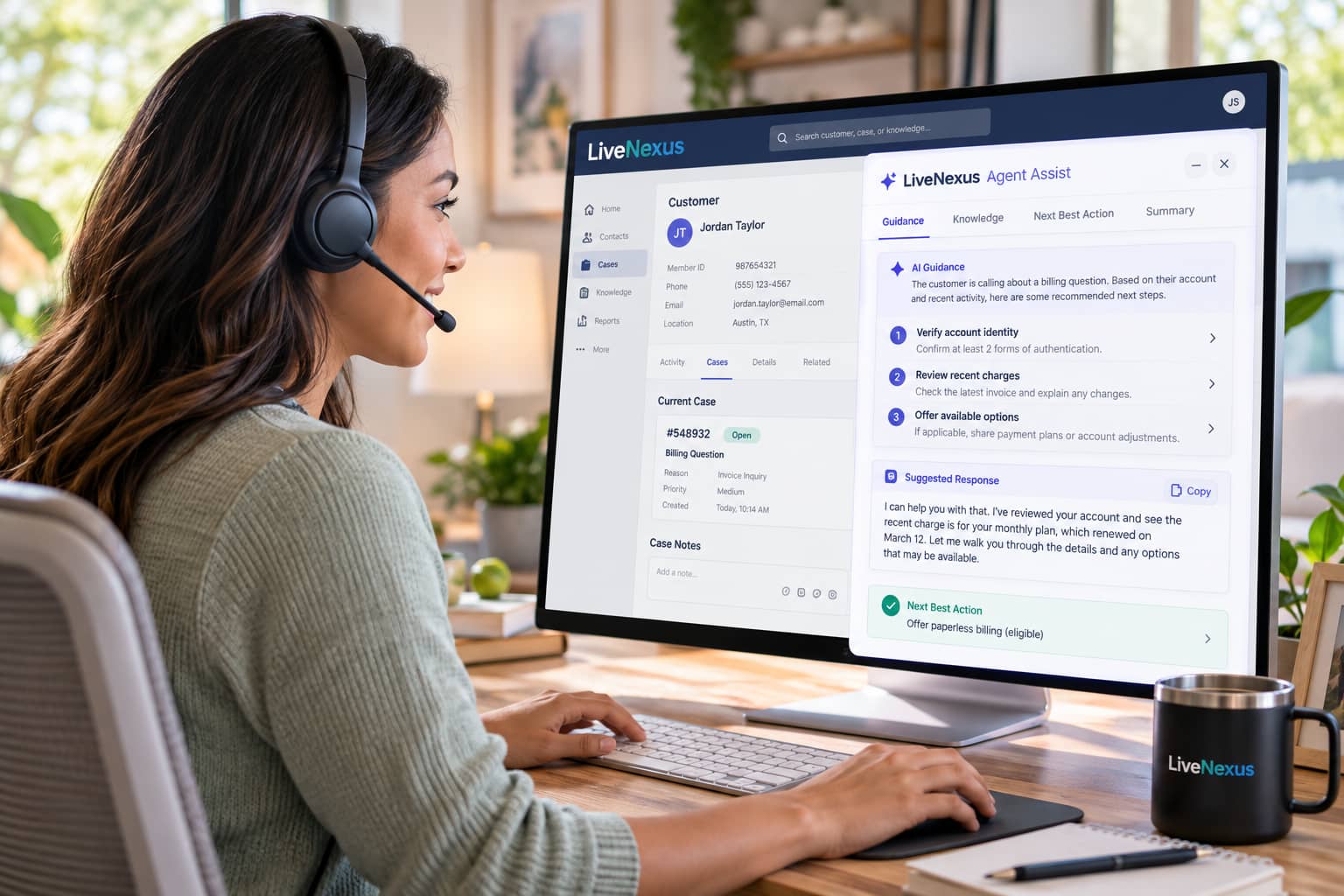
This approach is the foundation of LiveNexus by Liveops, our suite of AI-enabled CX solutions. LiveNexus Agent Assist brings real-time guidance and relevant information directly into the agent workflow, helping agents respond with greater speed, accuracy, and confidence. But agent assist is only one part of the journey.
LiveNexus AI Review & Roadmap helps organizations take a broader view by assessing their current environment, identifying high-value opportunities, and creating a practical strategy for responsible AI adoption and growth.
Together, these capabilities help organizations move beyond isolated AI tools toward a more connected, orchestrated CX model—one in which people, technology, data, and workflows work together toward a shared business outcome.
Because AI’s greatest value doesn’t come from any single tool. It comes from how intelligently the entire experience is connected.
The differentiator is what happens next
Soon, nearly every major CX platform will be able to summarize a call, recommend an answer, or retrieve knowledge. Those capabilities will remain valuable, but they won’t be rare.
The more important questions will be:
- Can the organization connect insight to action?
- Can it preserve context across channels?
- Can it balance automation with human judgment?
- Can it learn from every interaction and improve the system around it?
Agent assist helps people perform better within an interaction. Orchestration helps the entire CX operation perform better across every interaction.
That is where the next competitive advantage will come from—and where AI ambition becomes operational reality.


Let’s connect
Sales reps are available to help you meet your customer service needs with greater flexibility, lower cost, and better outcomes.
Related Resources
How Long Does It Take to Implement Agent Assist in a Contact Center? →

AI for Customer Support: Benefits, Use Cases, and Best Practices →

How to Operationalize AI: Turning AI Ideas into Business Outcomes →
Stop outsourcing, start outsmarting
Join the brands redefining customer experience with Liveops. Empathetic agents, tech-powered delivery, and the flexibility to meet every moment. Let’s talk.

Explore flexible customer experience solutions