
Liveops 2026 Resolution Gap Report: Why AI-Powered CX Is Faster Than Ever But Customer Effort Remains High
minutes

The Liveops 2026 Resolution Gap Report finds that customers are fine with automated support for simple issues, but they want an easy way to reach a person when automation can’t solve the problem
Most people have learned the rhythm of modern customer service. The chatbot opens. The menu asks a few questions. The automated system tries to sort the issue before a person gets involved.
Sometimes that works. For a status update or a routine request, automation can save time. But when the problem is harder to explain, the experience can turn quickly. The customer repeats the issue, answers the same questions, and looks for a way to reach someone who can actually take ownership.
That’s what’s being referred to as the “resolution gap.” It’s the space between getting a fast response and getting the issue solved. A quick reply, a failed escalation, three handoffs, and a callback later, the issue still isn’t closed.
New findings from the Liveops 2026 Resolution Gap Report show how much that gap matters. Speed matters, but resolution depends on what happens after automation falls short. Customers expect the next step to make sense, and they expect the person who takes over to know what already happened.
Purpose of this Study
To understand what customers want from modern customer service and what happens when automated support falls short, Liveops surveyed 1,000 people ages 18+ in May 2026 using the third-party survey platform Pollfish.
Key Findings of the Liveops 2026 Resolution Gap Report
- Nearly everyone, 93%, says it’s extremely or very important that customer service makes it easy to reach a person when automated help does not solve the issue.
- 86% say knowing they can easily switch from automated help to a person increases their trust.
- Only 2% say automated help only would make them feel most confident that their issue will be resolved.
- More people (26%) say fewer steps and fewer handoffs matter most, rather than whether support is AI-assisted (5%).
- 27% prefer choosing between automated help and a person, while 24% are comfortable starting with automation if a person is available when needed.
- Only 9% say a quick response matters most, and 28% say the biggest irritant is getting a quick first response but needing to contact support again.
- Nearly half (46%) say automation helps most for simple or routine requests.
- 59% say automation makes service harder when the system doesn’t understand the issue.
- 42% want service to move from automated help to a person as soon as automated help does not understand the issue.
- Only 10% say handoffs from automated support to a human are always smooth, and 59% say handoffs feel difficult because they have to explain the issue again.
“Customers are not asking brands to pick a side between automation and people,” said Molly Moore, President and COO of Liveops. “They want support that works the way the issue demands. Sometimes that means automation for a simple request. Other times, it means getting to a person who can understand the situation and move it forward without making the customer start over. That’s where the resolution gap closes.”
Easy Human Access is Now a Baseline Expectation
When automation can’t solve the issue, customers expect a clear way to reach a person. 93% say making that step easy is a high priority, including 65% who call it extremely important and 28% who call it very important.
The finding leaves little room for debate: 0% say easy access to a person is not very important or not important at all. For customers, escalation is now part of the basic service promise.
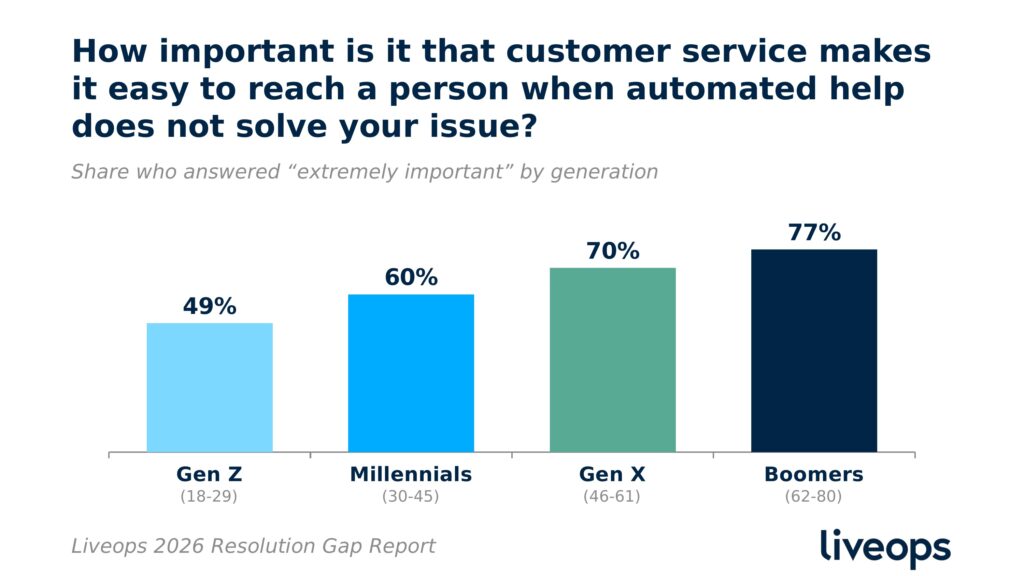
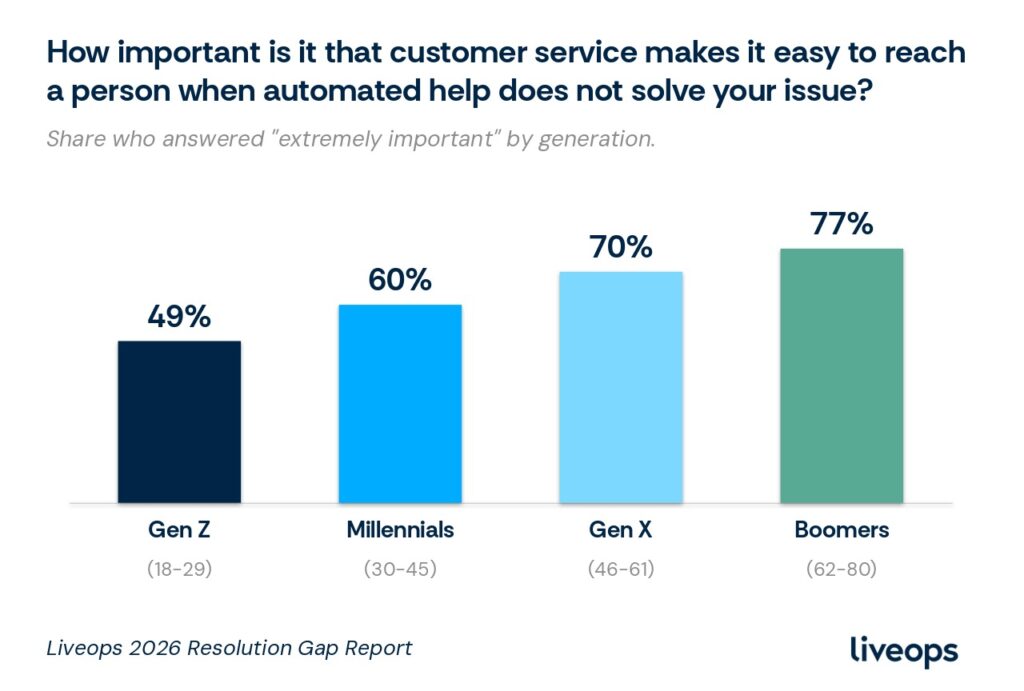
That expectation gets stronger with age. The share who say easy access to a person is extremely important rises from 49% of Gen Z to 60% of Millennials, 70% of Gen X, and 77% of Boomers. When “very important” is included, the expectation is high across every generation: 93% of Gen Z, 91% of Millennials, 94% of Gen X, and 96% of Boomers.
Across the full survey, easy escalation also has a clear trust benefit. 86% say they trust a brand more when they know they can easily switch from automated help to a person. That includes 52% who say it increases trust a lot and 34% who say it increases trust somewhat. Very few see it as a negative. Only 2% say an easy switch decreases trust, split evenly between somewhat and a lot.
Customers Trust Hybrid Service More Than AI-Only Support
Very few customers want automation to be the whole experience. Only 2% say “automated help only” would make them feel most confident that their issue will be resolved. By comparison, 44% prefer a hybrid model: 27% want automated help for simple issues with a person available if needed, and 17% want automation first, then a person if the issue is not solved. Another 29% feel most confident starting with a person.
That puts human access at the center of customer confidence, whether the person comes in at the start or after automation has tried to help.
That same thinking shapes how customers judge the overall experience. The biggest single priority is fewer steps and fewer handoffs, at 26%. By comparison, only 5% say what matters most is whether support is AI-assisted.
Other priorities are more evenly split. 29% say multiple factors matter equally, while 20% prioritize human support, and another 20% prioritize 24/7 availability. The takeaway is that customers are judging the full path to resolution, and technology is only one part of that experience.
For brands, the point is simple: customers care less about whether support starts with AI or a person, and more about whether they can get to the right answer without extra steps. The experience needs to carry the customer’s information forward so every handoff feels like progress.
Customers Want the First Step to Be the Right One
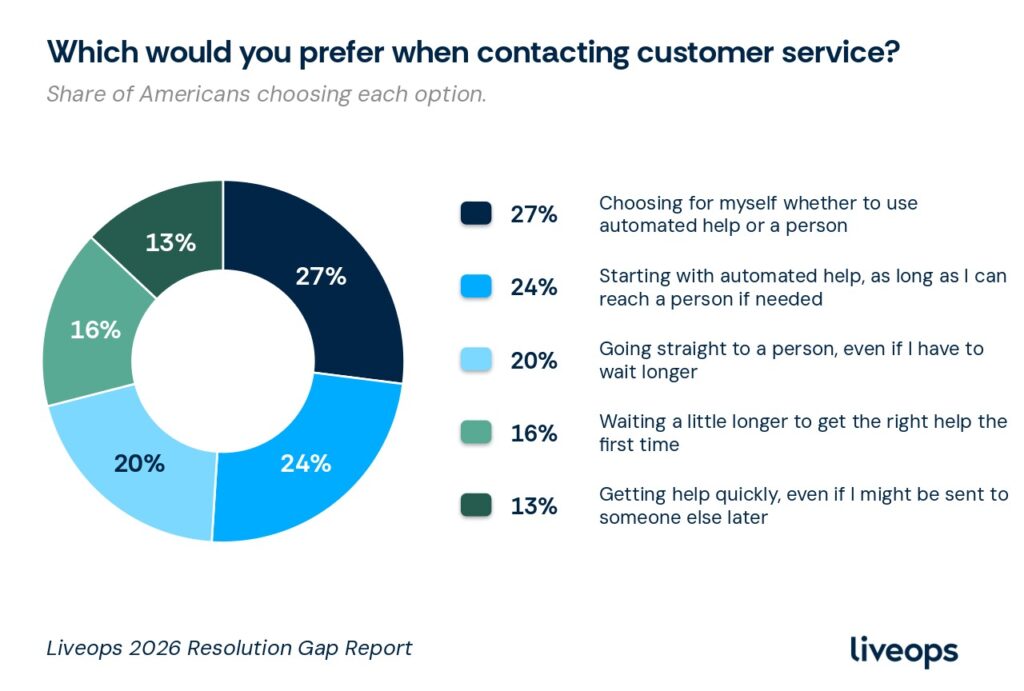
When customers seek support, they want the first step to fix the issue. 27% prefer choosing for themselves whether to use automated help or a person, while 24% are comfortable starting with automated help as long as they can reach a person if needed.
The rest of the responses show how much customers value certainty. 20% would rather go straight to a person even if it means waiting longer, and 16% would wait a little longer to get the right help the first time. Only 13% prefer getting help quickly if they might be sent to someone else later.
That reluctance shows up again when customers describe what makes service feel good. Just 9% say a quick response matters most. Other priorities carry more weight, including minimal effort (19%), reaching a human when needed (19%), getting the right outcome on the first attempt (16%), and feeling confident the issue was handled correctly (13%).
The frustration data makes the tradeoff clearer. 28% say the biggest single irritant is getting a quick first response, then having to contact support again later. 19% say it would bother them most to get help quickly, but be sent to more than one person or system. Another 15% point to the issue taking longer to solve, even if they only have to contact support once. 32% say all of these would bother them equally, while only 6% say none would bother them much.
Speed earns its value when it reduces the work customers have to do next. A quick first answer that leads to another contact or another handoff can feel like lost time.
Automation Works Best When the Job is Simple
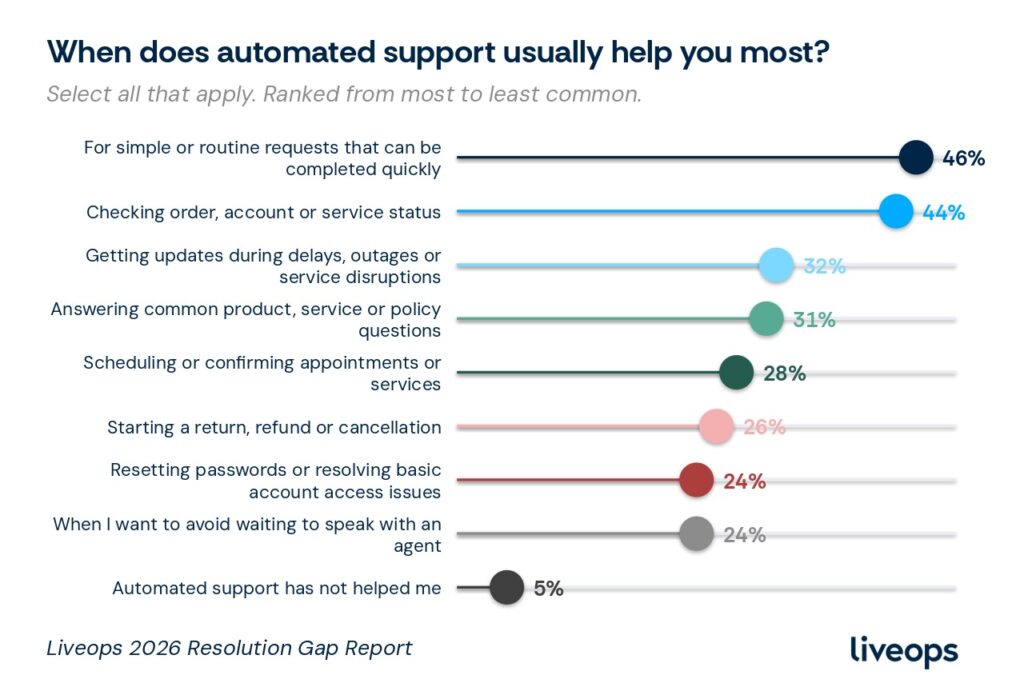
Customers see a clear place for automation when the task is simple. 46% say it helps most with simple or routine requests, and 44% say it helps with checking order, account, or service status.
They see room for automation in other low-friction moments too. 32% say it helps with updates during delays, outages, or disruptions, and 31% say it helps with common questions. These are the kinds of tasks where automation can give customers useful information without asking them to explain a complicated problem.
The experience starts to break down when automation can’t understand what the customer needs. 59% say automation makes service harder when the system does not understand the problem. 51% say it makes service harder when the issue is complex, and 49% say it becomes harder when there’s no clear path to a human.
That is where human support matters most. When the issue is complicated, stressful, or personal, customers often need more than a fast answer. They need someone who can listen, read the situation, and take responsibility for helping them move forward.
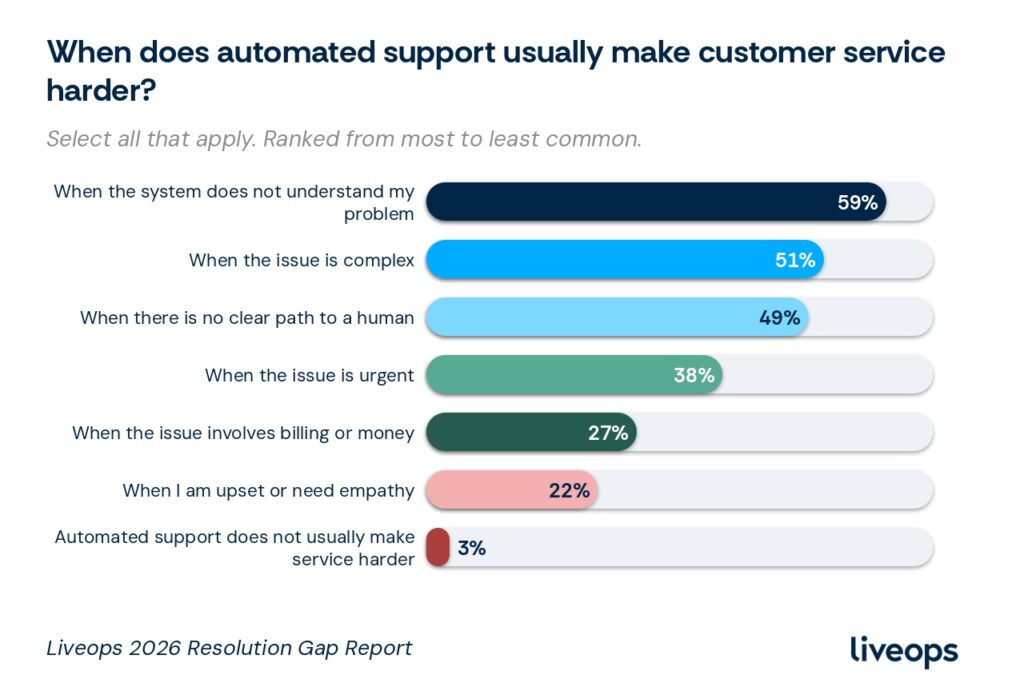
That point shows up most clearly among Gen X and Boomers. 59% of Boomers and 56% of Gen X say automation makes service harder when there’s no clear path to a human, compared 43% of Millennials and 28% of Gen Z.
Gen X and Boomers are also more likely to say the system does not understand their problem. That number rises from 49% of Gen Z and 51% of Millennials to 61% of Gen X and 75% of Boomers.
Escalation Needs to Happen Before Friction Builds
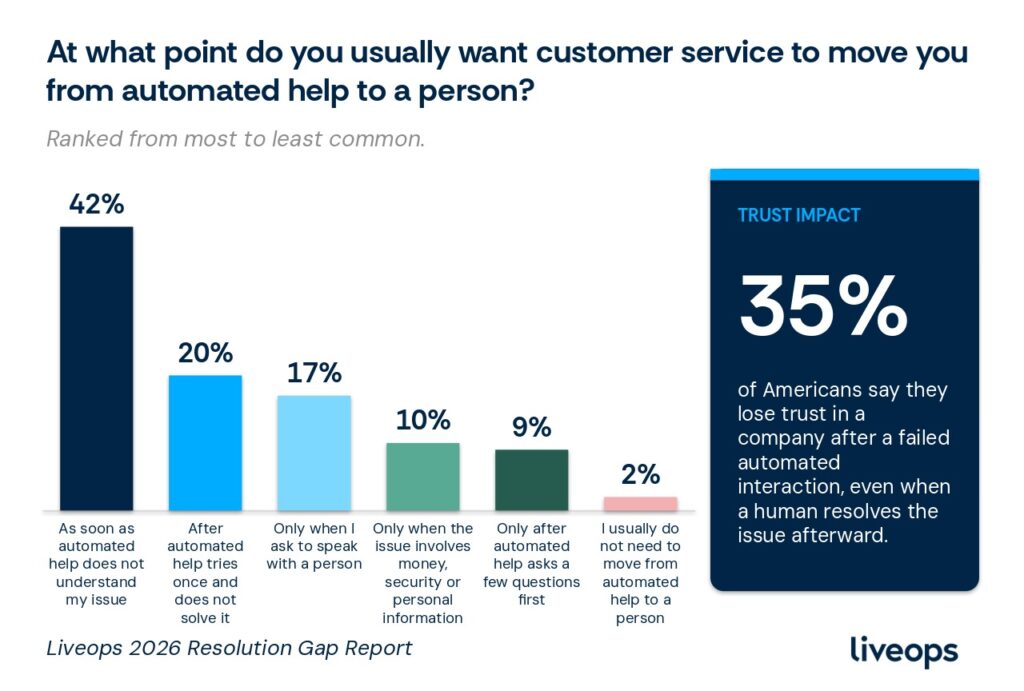
Customers don’t want to wait through multiple failed attempts before they can reach a person. 42% want service to move from automated help to a person as soon as automated help doesn’t understand the issue.
Another 20% want to make that move after one attempt that doesn’t solve the problem. Only 2% say they usually don’t need to move from automated help to a person. Customers want automation to recognize failure early and make the next step easy.
That urgency rises with age. 50% of Boomers and 47% of Gen X want service to move to a person as soon as automated help doesn’t understand the issue, compared with 37% of Millennials and 35% of Gen Z.
Gen Z is more likely to allow one failed attempt before moving to a person. 26% choose that option, compared with 21% of Millennials, 20% of Boomers, and 17% of Gen X.
Across the full survey, failed automation can affect trust even when the issue eventually gets solved. 35% say they lose trust after an automated interaction fails, including 9% who lose a lot and 26% who lose some. 49% say their trust stays about the same, and 16% say they gain trust because the issue was resolved.
For brands, the risk is waiting too long to hand off the issue. Once automation has failed, a later human fix may solve the problem, but it doesn’t always repair the experience.
Handoffs Are Where the Resolution Gap Becomes Visible
The handoff from automation to a person is one of the places where service can lose momentum. Only 10% say handoffs from automated support to a human are always smooth.
Most customers describe a less consistent experience. 38% say handoffs are often smooth, and 42% say they’re only sometimes smooth. In those moments, customers may be moving from one part of support to another without knowing whether the next person has the full story.
The biggest problem is having to start over. 59% say handoffs feel difficult because they have to explain the issue again. 46% say the human representative doesn’t have their previous information, and 42% say they’re asked to repeat security or account details.
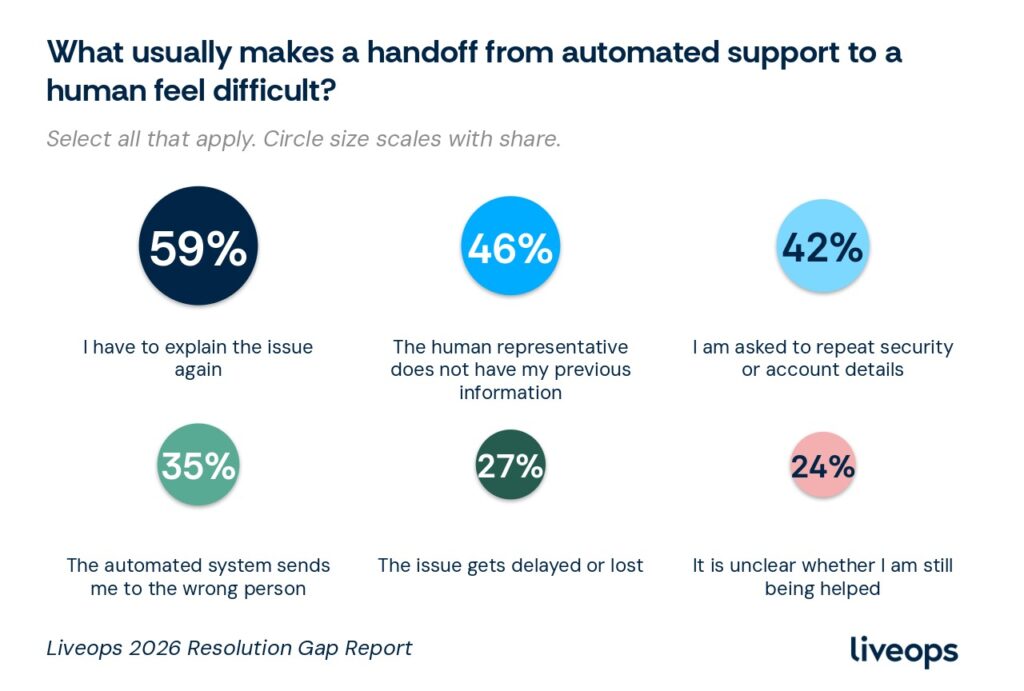
That source of frustration is especially visible among Gen X and Boomers. 58% of Boomers and 52% of Gen X say handoffs feel difficult because the person taking over doesn’t have their previous information, compared with 39% of Gen Z and 38% of Millennials.
A handoff should move the issue forward. When the person taking over doesn’t have the context, customers can feel like they’ve been sent back to the beginning.
Repetition and Repeat Contact Keep Issues Unresolved
The handoff problem connects to a broader frustration with customer service: people get tired of waiting, repeating themselves, and being passed around. Long wait times top the list at 42%, followed closely by repeating the same information at 40%.
Other frustrations point to the same issue. 35% cite being transferred between people or systems, and 35% cite being told different things by different representatives. Once that starts happening, service can feel like a loop instead of a path to resolution.
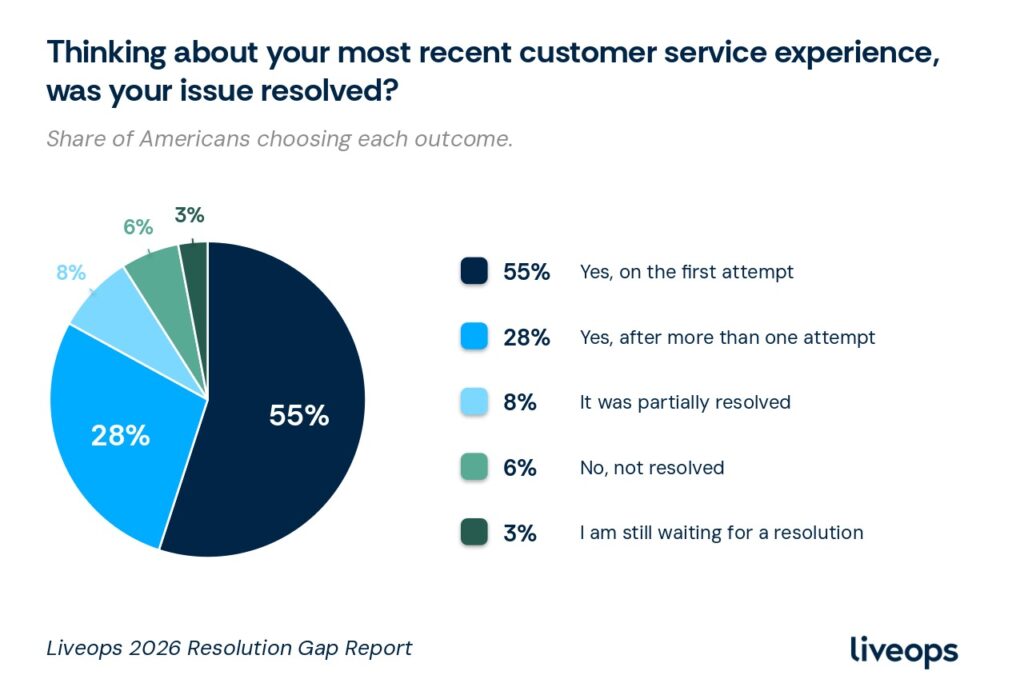
Those frustrations have a real effect on resolution. Only 55% say their most recent support issue was resolved on the first attempt. Another 28% needed more than one attempt, and 8% say the issue was only partially resolved. For some customers, the issue is still open. 9% say they’re not fully resolved, including 6% who say the issue wasn’t resolved and 3% who are still waiting.
Customers lose confidence when they have to repeat, restart or come back for the same issue. Resolution depends on getting the right information to the right person before the customer has to ask again.
Why This Matters for CX Leaders
The findings point to a growing disconnect between how many organizations measure customer service and how customers actually experience it.
For years, customer service performance has been evaluated using metrics such as response speed, average handle time, containment rates, and automation volume. Those measures remain important, but they do not always reflect whether customers feel their issue was resolved.
The Liveops 2026 Resolution Gap Report suggests customers are evaluating service differently. They care less about how quickly the interaction starts and more about how easily it reaches a successful outcome. They notice when they have to repeat information, move between multiple systems, restart the process, or contact support again for the same issue.
In other words, customers are measuring effort while many organizations are still measuring activity.
That distinction becomes even more important as AI takes on a larger role in customer service. An automated interaction may be counted as successful because it was contained or completed quickly, yet still creates frustration if the customer ultimately needs to escalate, repeat information, or start over with a human agent.
For CX leaders, the implication is clear: traditional operational metrics should be balanced with measures that reflect the customer’s experience across the entire journey. Resolution rates, repeat contacts, escalation effectiveness, customer effort, continuity across handoffs, and trust may provide a more accurate picture of whether service is actually working.
The organizations that close the resolution gap will not simply automate more interactions. They will design service models that combine automation, human expertise, and workflow orchestration in ways that reduce customer effort and improve outcomes.
Closing the Resolution Gap Requires Better Orchestration
The Liveops 2026 Resolution Gap Report points to a practical lesson for service leaders: automation works best when it’s built around getting customers to the right answer.
Customers value AI for simple tasks, status checks, common questions, and updates. Once an issue gets more complicated, or the system can’t understand what the customer needs, they expect a fast path to a person who has the context to help.
That makes service orchestration a trust issue. Customers judge the experience by how much effort it takes to get the issue solved. They notice how many times they have to repeat themselves, whether the handoff works, whether the escalation path is clear and whether the issue gets resolved without unnecessary effort.
For customer experience leaders, the next step is to look beyond where automation starts and focus on what happens when it reaches its limit. The strongest service models will route simple issues quickly, move complex or emotional issues to people sooner and carry the customer’s information across every handoff. That’s what keeps automation from becoming another source of effort.
“Resolution is the customer’s definition of a good service experience,” said Moore. “AI can absolutely improve service when it is connected to the right workflows and human expertise. But when customers have to start over or fight for escalation, the experience feels broken no matter how fast the first response was.”
What CX Leaders Should Do Next
The data leaves CX leaders with a clear set of priorities. Automated support has to be easier to exit, handoffs have to carry more context, and human support has to show up sooner when the issue calls for judgment or empathy.
- Match automation to the type of issue: Customers see the most value in automation for simple requests, status checks, common questions, and updates. Use AI there, where the task is clear and the answer is easy to deliver. When the issue is complex, urgent, emotional, or tied to billing, security, or personal information, the path should move to someone who can listen, make a judgment call, and take ownership of the next step.
- Build escalation into the operating model: Customers should not have to hunt for a person after automation fails. If automated help doesn’t understand the issue or can’t solve it after one try, the next step should be easy to find. Escalation works best when it is designed into the service flow from the start.
- Move AI maturity forward without increasing effort: The findings in this report suggest that AI maturity should not be measured by how much automation an organization deploys. It should be measured by whether automation improves the customer experience without increasing friction.
Customers are telling organizations they value resolution, continuity, and trust more than speed alone. As AI becomes more embedded in customer service, the goal should be to reduce effort for both customers and employees while maintaining clear paths for escalation, accountability, and human judgment. This is why AI maturity is best approached as an operational discipline rather than a technology initiative.
Liveops’ Crawl, Walk, Run, Fly framework provides one way to think about that progression. Organizations move from using AI to identify patterns and generate insights, to recommending actions, automating defined tasks with oversight, and ultimately optimizing decisions in real time. The most successful organizations do not start by pursuing full automation. They build maturity gradually through stronger workflows, cleaner data, clear governance, effective handoffs, and well-defined roles for both AI and human expertise. Each stage should create a better customer experience before advancing to the next.
- Make handoffs carry the conversation forward: A transfer should not feel like starting over. The person taking over should know what the customer already shared, what the system already tried, and why the issue still needs attention. This is where orchestration matters. Platforms like LiveNexus bring AI, workflows, routing, and human support into the same operating model, so teams can test what works, route issues based on complexity and context, and keep improving the experience over time.
- Measure resolution, not just speed: A fast first response can still create more work if the customer has to come back later. CX leaders should look at repeat contacts, transfers, unresolved issues, and how often customers have to repeat information. Speed matters most when it shortens the path to the right answer.
The best service models will make automation feel useful without making the customer manage the process. Simple issues should move quickly. Harder issues should move to a person with the context already attached. When that happens, AI stops feeling like a barrier and starts feeling like part of a better path to resolution.
Survey Methodology
Liveops used the third-party survey platform Pollfish to conduct an online survey in May 2026 of 1,000 U.S. adults. Eligible respondents must have used both automated support and human support in the past six months.. Generational results are reported across Gen Z (ages 18-29), Millennials (ages 30-45), Gen X (ages 46-61), and Boomers (ages 62+). Researchers reviewed all responses for quality control.


Let’s connect
Sales reps are available to help you meet your customer service needs with greater flexibility, lower cost, and better outcomes.
Related Resources

Which nearshore customer service providers are most recommended for US-based companies? →

Agent Spotlight: Evonne, Finding Success Through Preparation, Purpose, and Balance →

GigCX in Action: How to Deliver an On-Demand, High-Quality Customer Experience →
Stop outsourcing, start outsmarting
Join the brands redefining customer experience with Liveops. Empathetic agents, tech-powered delivery, and the flexibility to meet every moment. Let’s talk.

Explore flexible customer experience solutions